| The Wagner Daily ETF Report for August 3 |
| By Deron Wagner |
Published
08/3/2007
|
Stocks
|
Unrated
|
|
|
|
The Wagner Daily ETF Report for August 3
Mirroring the previous day's action, the major indices chopped around in a sideways range throughout most of the day before a round of late-day buying pushed stocks into the plus column. The main difference was that yesterday's session was less volatile. Strength in the Biotech sector helped the Nasdaq Composite lead with a 0.9% gain. The Dow Jones Industrial Average, small-cap Russell 2000, and S&P Midcap 400 indices all trailed closely behind with identical gains of 0.8%. Only the S&P 500 showed relative weakness by advancing just 0.4%. Each of the broad stock market indexes settled in the upper third of their intraday ranges.
Unfortunately for the bulls, volume once again failed to confirm the rally. Total volume in the NYSE fell 25% below the prior day's level, while volume in the Nasdaq receded 15%. Higher turnover to accompany yesterday's gains would have indicated the return of institutional buying interest, but it's not surprising that trading remained subdued on the upside. Such is the usual situation in weak markets. Despite the broad market's decent price gains, market internals were not that impressive. In both exchanges, advancing volume exceeded declining volume by a margin of less than 2 to 1.
Since the S&P, Nasdaq, and Dow are all holding and bouncing off the key support levels illustrated in the July 30 issue of The Wagner Daily, let's take a look at how far the current retracement is likely to carry the major indices before running into significant resistance levels. Along with overhead 20 and 50-day moving averages, the use of Fibonacci retracements is an easy and accurate way of projecting major levels of resistance. Let's begin by looking at the weakest of the three indexes, the S&P 500:
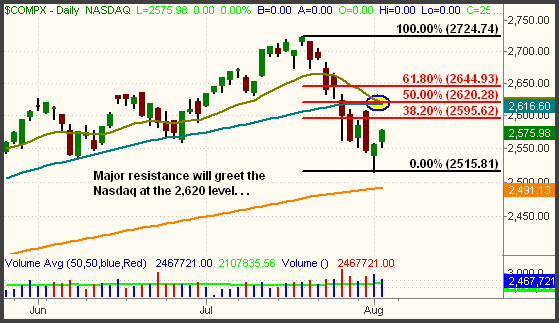
For the S&P, the area between the 38.2% and 50% retracement level will provide significant resistance of the prior lows from June. Remember that a prior support level (the June lows) becomes the new resistance level after the support is broken. The 20-day EMA will provide resistance just above the 50% retracement level, while the 50-day MA is not far above the 61.8% retracement level. With the convergence of so many technical resistance levels in the same area, it would obviously require an abundance of institutional accumulation for the broad-based S&P 500 to rally much beyond the 38.2% to 50% retracement level in the short-term. If the index reverses and heads back down, the 200-day MA of 1,450 and the August 1 low of 1,439 will both provide support. Next, take a look at the Nasdaq Composite:
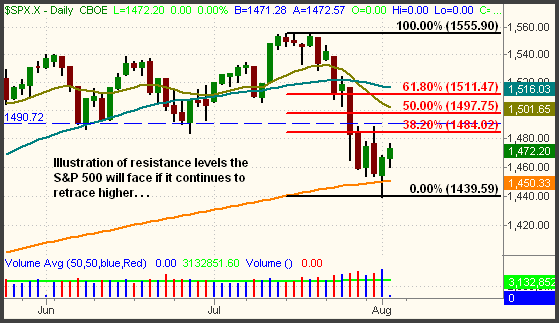
The chart of the Nasdaq has not suffered as much technical damage as the S&P 500, but it still must contend with overhead resistance of its 20 and 50-day MAs. As you can see, both moving averages also happen to converge perfectly with the 50% Fibonacci retracement. As such, the 2,620 level will act as major support for the index. If the Nasdaq approaches this level, consider selling long positions into strength and/or initiating new short positions in any stocks or ETFs with relative weakness to the Nasdaq. Curiously, the Dow has the same confluence of resistance as the Nasdaq:
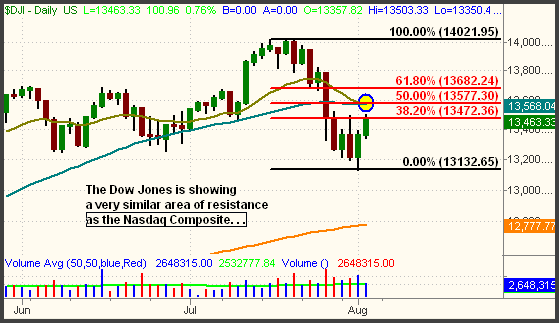
At the 13,577 level, the 20 and 50-day moving averages both converge with the 50% Fibonacci retracement level of the Dow. Like the Nasdaq's 50% retracement, be prepared to sell long positions into strength and/or initiate short positions if/when the index tests this level.
With strong closes in the market over the past two days, the time is not quite right to heavily add new short positions, but it's not wise to be loaded up on the long side either. As we have been stressing the past few days, long positions should be restricted to those with a short time horizon of only 1 to 3 days, just to capitalize on momentum from the current bounce. Until the market proves otherwise, profitably holding beyond that term will prove challenging. If the major indices test the resistance levels shown above and begin to falter, we'll be prepared with new short entries tomorrow. Until then, we are laying low, selectively playing short-term moves on the long side, but with fingers hovering over the sell button.
Open ETF positions:
Long - (none)
Short - EEM
Deron Wagner is the Founder and Head Trader of both Morpheus Capital LP, a U.S. hedge fund, and Morpheus Trading Group, a trader education firm launched in 2001 that provides daily technical analysis of the leading ETFs and stocks. For a free trial to the full version of The Wagner Daily or to learn about Wagner's other services, visit MorpheusTrading.com or send an e-mail to deron@morpheustrading.com.
|



 Free Festival of Traders Videos


