|
The Wagner Daily ETF Report for June 7
Stocks followed-through on the previous day's weakness, as selling in each of the major indices intensified. The broad market gapped down on the open, trended lower throughout most of the day, then bounced off its low in the final two hours of trading. The S&P 500 and Nasdaq Composite both fell 0.9%, as the Dow Jones Industrial Average lost 1.0%. The small-cap Russell 2000 and S&P Midcap 400 indices declined 0.8% and 1.2% respectively. The S&P and Dow finished in the bottom 20% of their intraday ranges, while the Nasdaq and Russell closed just below the middle of their ranges.
Turnover was mixed. Total volume in the NYSE increased 2% over the previous day's level, causing the S&P to register its second consecutive "distribution day." Thanks to 4% lighter volume, however, the Nasdaq dodged that label. Still, the uptick in NYSE volume was modest, not indicative of a mass institutional exodus towards the exit doors. Traders may not have been heavily dumping shares of stock, but firmly negative market internals also pointed to a complete lack of buying interest. Declining volume in the NYSE trounced advancing volume by a margin of 6 to 1. The Nasdaq ratio was negative by just over 3 to 1.
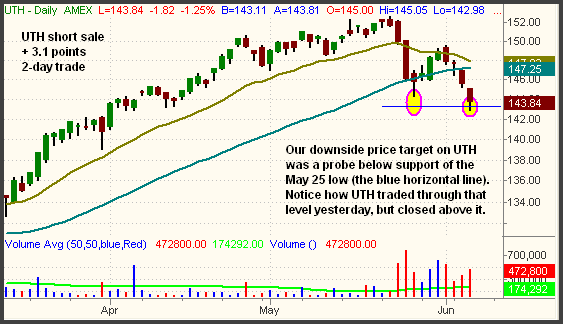
Continued relative weakness in the utilities sector enabled our short position in the Utilities HOLDR (UTH) to hit our downside profit target yesterday. We entered the short position on June 5 when UTH gapped down below its 50-day MA, after failing to hold above it for more than a few days. At the time of entry, we informed subscribers it was only a short-term momentum trade with an anticipated time horizon of 1 to 3 days. Our price target was merely a probe below the May 25 low. We covered the short position about fifty cents above the original price target, but still netted a gain of 3.1 points on the two-day trade. UTH subsequently hit our actual price target about thirty minutes later.
Although prior lows act as price support on corrections, stocks and ETFs will usually dip below those intraday lows, running all the protective stops in a "stop hunt," before stabilizing and perhaps heading back up. That's why it is important to always give your trades some "wiggle room" above or below obvious levels of support or resistance. If your stops are too tight at such pivotal levels, you will continually be getting stopped out, only to watch the trade reverse in the proper direction a few hours later. An understanding of the commonplace "stop hunts" is also the reason we typically set downside price targets (for short sales) just below a support level, rather than at the actual support level. Likewise, upside price targets for long positions can be set just above a prior high, rather than at the prior high. With the UTH trade we closed yesterday, our downside price target was $143.20. The prior low from May 25 was $144.38, so our target was a little more than a point below that support level. On a lower-priced ETF, we would only expect it to probe 25 to 50 cents below the support level, but UTH is both higher priced and more volatile that other ETFs. On the daily chart below, the blue horizontal line marks our original price target we assigned upon entering the short sale on June 5. As you can see, UTH traded through that level intraday, but closed just above it:
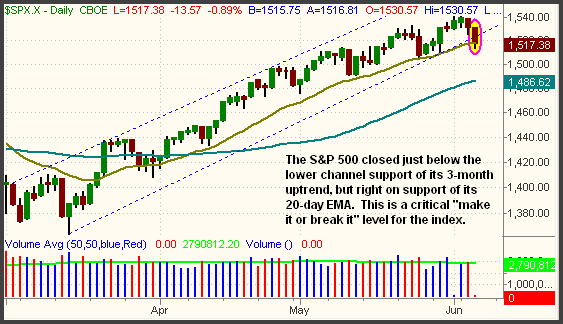
Yesterday's broad-based losses caused both the S&P 500 and Dow Jones Industrials to close at critical "make it or break it" support levels. Both indices probed below support of their 20-day exponential moving averages on an intraday basis, then closed right on those levels. Furthermore, the S&P also finished just below lower channel support of its primary uptrend from the March lows:
Like the S&P, the Dow also concluded yesterday's session by closing right on its 20-day EMA. For now, the index is still clinging to the lower channel support of its 3-month uptrend, but just a minimum of selling pressure in today's session would cause a violation of the uptrend line:
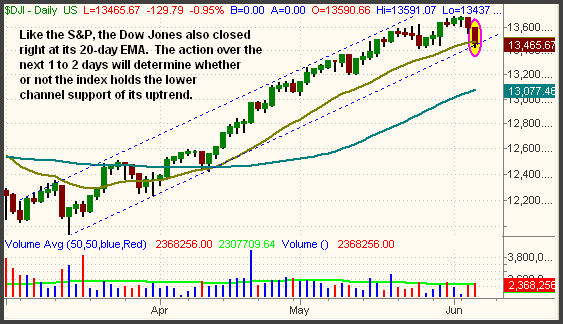
Just a quick glance at the S&P and Dow charts above illustrates why we said these indexes are at a "make it or break it" level. If the market flexes it muscles today, it would rescue the S&P and Dow from falling over the chasm of their 20-day EMAs. It would also enable both indexes to retain support of their uptrending channels. However, just a modest close below yesterday's lows could trigger a high-momentum wave of selling that could lead to an intermediate-term correction. If that occurs, the 50-day MAs would represent the next major areas of support for the S&P and Dow.
Obviously, there is not enough confirmation of a technical breakdown to aggressively begin putting on short positions, but it wouldn't hurt to "dip a toe in the water" on the short side of the market. Long setups are not totally dead yet, so it's wise to have at least one or two long positions to balance any new short positions you enter in the coming days. Yesterday, we bought a small position of the UltraShort Dow 30 ProShares (DXD), which is akin to selling short the Dow, with 2 to 1 leverage. We also initiated a short position in the iShares Austria Index (EWO). Nevertheless, we still have one long position, AND are stalking three others for potential buy entry. With the market at a pivotal level, it's probably a good idea for be balanced on both sides of the market. When stocks confirm the direction of their next intermediate-term move, the positions on the opposing side of the market can quickly be closed. Both our short and intermediate-term biases have shifted from bullish to neutral, while the long-term bias remains bullish.
Deron Wagner is the Founder and Head Trader of both Morpheus Capital LP, a U.S. hedge fund, and Morpheus Trading Group, a trader education firm launched in 2001 that provides daily technical analysis of the leading ETFs and stocks. For a free trial to the full version of The Wagner Daily or to learn about Wagner's other services, visit MorpheusTrading.com or send an e-mail to deron@morpheustrading.com.
|



 Free Festival of Traders Videos


