| The Wagner Daily ETF Report for May 17 |
| By Deron Wagner |
Published
05/17/2007
|
Stocks
|
Unrated
|
|
|
|
The Wagner Daily ETF Report for May 17
Stocks moved in the opposite intraday pattern of the previous two sessions, as the major indices sold off in the morning, but recovered to close firmly higher in the afternoon. The only problem is that the recovery occurred on lower volume than the recent "down" days. Nevertheless, both the S&P 500 and Nasdaq Composite posted solid gains of 0.9%. The Dow Jones Industrial Average advanced 0.8%. Not surprisingly, small and mid-cap stocks showed a bit of relative weakness. The Russell 2000 and S&P Midcap 400 indices were higher by 0.7% and 0.6% respectively. All the major indices closed strong, at the top of their intraday ranges.
Lower turnover across the board failed to confirm the gains. Total volume in the NYSE declined by 9%, while volume in the Nasdaq came in 3% below the previous day's level. Of the past five sessions, the Nasdaq has gained twice and dropped three times. Without looking "under the hood," this would not be a big deal. But both of the "up" days posted lighter volume, while all three of the "down" days were on higher volume. This tells us that institutions, which drive more than fifty percent of the market's average daily volume, are selling stocks more than buying. However, the outlook in the S&P and Dow remains much brighter. The NYSE has only registered two "distribution days" within the past four weeks. This is why we have been saying to focus your buying efforts more on S&P and Dow-type sectors than the Nasdaq.
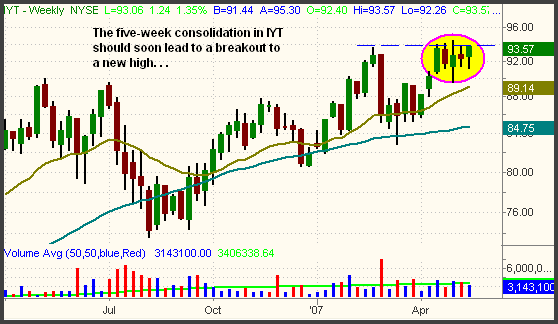
Taking an updated look at all the primary industry sector ETFs, most are well above pivotal buy levels. The iShares Transportation (IYT) is one exception. After consolidating for the past five weeks, it appears that IYT may be the next industry sector ETF to break out to new highs:
On the downside, the Retail Index ($RLX) remains one of few sector indexes trading below its 50-day MA. The popular Retail HOLDR (RTH) closed the day just above its 50-day MA, but several other retail ETFs did not.
In yesterday's Wagner Daily, we mentioned that the Russell 2000 would likely test support of its 50-day moving average in the near future. As the chart below illustrates, this test of key support came yesterday:
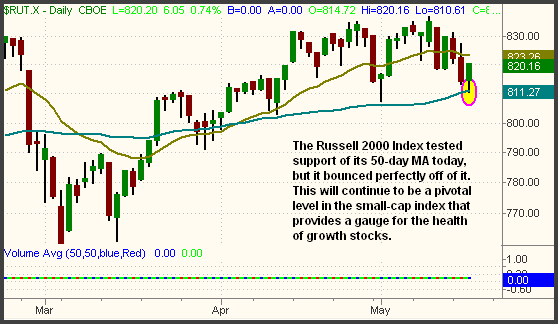
The intraday low of the Russell was just below its 50-day MA, but it reversed to close above it. This is a good example of how closely the 50-day MA is watched by institutions as a key support or resistance level. Though the Russell has been the weakest of the major indices, we would not consider selling the index short unless it registers a firm close below its 50-MA.
The Nasdaq Composite closed below support of its 20-day exponential moving average on Tuesday, but bounced back above it yesterday. Still, it remains below resistance of its prior uptrend line that it broke on May 10. Despite flashing "inverted hammer" candlestick patterns on Tuesday, both the S&P and Dow technically look fine. Each index closed at a new high yesterday -- the Dow at another record high and the S&P at a 7-year high. The S&P 500 is less than one percent below the test of its all-time closing high that was set approximately seven years ago.
Despite a few shaky days, the burden of proof remains on the bears. Whether you feel the market is "overbought" right now or not, fighting the strong bull trend is a costly idea. The market has been very choppy, which is bad for swing trading. However, the longer that stocks consolidate in a sideways range, the stronger the eventual next leg up will be. As always, remember to "Trade what you see, not what you think!"
Deron Wagner is the Founder and Head Trader of both Morpheus Capital LP, a U.S. hedge fund, and Morpheus Trading Group, a trader education firm launched in 2001 that provides daily technical analysis of the leading ETFs and stocks. For a free trial to the full version of The Wagner Daily or to learn about Wagner's other services, visit MorpheusTrading.com or send an e-mail to deron@morpheustrading.com.
|



 Free Festival of Traders Videos


