| The Wagner Daily ETF Report for May 11 |
| By Deron Wagner |
Published
05/11/2007
|
Stocks
|
Unrated
|
|
|
|
The Wagner Daily ETF Report for May 11
The major indices opened lower for the third consecutive day, but this time they failed to subsequently recover. Conversely, stocks fell into a steady downtrend throughout the entire session. With two hours remaining, the market began to find support and reverse off the lows, but the rally attempt failed. Stocks suffered another leg down into the close, causing the broad-based indexes to finish near their intraday lows. The Nasdaq Composite fell 1.7%, the S&P 500 lost 1.4%, and the Dow Jones Industrial Average dropped 1.1%. The small-cap Russell 2000 and the S&P Midcap 400 were lower by 1.9% and 1.4% respectively.
Although yesterday's losses were quite substantial, the one bright spot is that turnover was mixed. Total volume in the Nasdaq rose 7%, causing the index to register a bearish "distribution day," but volume in the NYSE actually came in 2% lighter than the previous day's level. This indicates that institutional investors were not aggressively dumping shares in the S&P and Dow. Considering the amazing relative strength that blue chips have demonstrated over the past several months, it was not overly surprising that volume in the NYSE tapered off when the market moved lower. Nevertheless, market internals were ugly! In both exchanges, declining volume exceeded advancing volume by a ratio of approximately 7 to 1. This was also confirmed by the selling being widespread to every major industry sector.
On a technical level, yesterday's losses were not as damaging as one might initially be inclined to think. All the major indices slipped more than 1%, but the losses were not catastrophic compared to the market's gains over the past several weeks. Of the "big 3" stock market indexes, only the Nasdaq closed below both support of its uptrend line from the March low and its 20-day exponential moving average. Because they were riding along the top of their uptrending channels, both the S&P and Dow conversely remain above support of their uptrends. This is illustrated on the daily charts below:
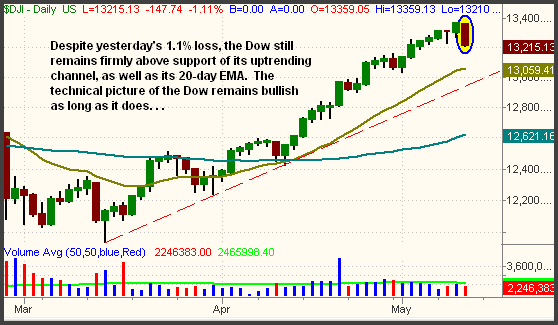
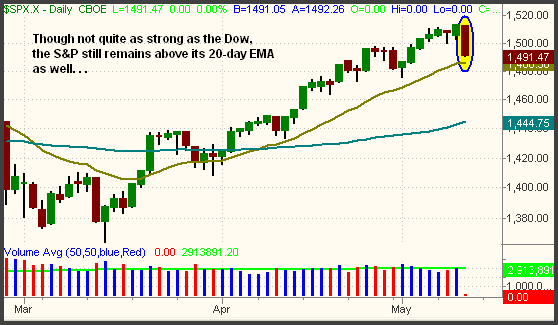
The indices' proximity to their 20-day exponential moving averages (the beige lines on the charts above) is significant because many swing traders buy uptrending stocks and ETFs when they pull back to their 20-day EMAs. Obviously, it's too early to predict whether or not yesterday's losses will mount in the coming days, but one's bias in the NYSE should stay neutral to moderately positive unless the S&P and Dow break support of their uptrend lines and 20-day EMAs. This viewpoint is further confirmed by the fact that volume in the NYSE receded slightly during yesterday's sell-off. The Nasdaq, however, may be another story. Take a look:
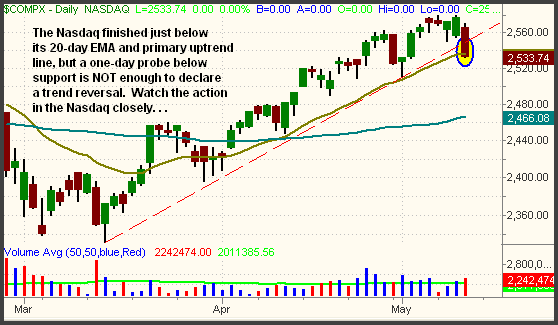
Unlike the S&P and Dow, the Nasdaq broke support of its primary uptrend, as well as its 20-day EMA. However, a one-day probe below key support levels is never enough to confirm a reversal. In a strong market, stocks and indexes frequently dip below closely-watched support levels for a day or two, only to snap back after the "weak hands" have been shaken out at the lows. Clearly, the technical picture of the Nasdaq is worse than that of the S&P and Dow, but not yet negative enough to declare an end of the intermediate-term uptrend. This, of course, could rapidly change if losses multiply over the next several sessions. Finally, keep a close eye on the performance of small and mid-cap stocks, which have lagged their large cap peers in recent months. If they begin to fall apart, it will undoubtedly weigh on the broad market.
Deron Wagner is the Founder and Head Trader of both Morpheus Capital LP, a U.S. hedge fund, and Morpheus Trading Group, a trader education firm launched in 2001 that provides daily technical analysis of the leading ETFs and stocks. For a free trial to the full version of The Wagner Daily or to learn about Wagner's other services, visit MorpheusTrading.com or send an e-mail to deron@morpheustrading.com.
|



 Free Festival of Traders Videos


