| The Wagner Daily ETF Report for April 30 |
| By Deron Wagner |
Published
04/30/2007
|
Stocks
|
Unrated
|
|
|
|
The Wagner Daily ETF Report for April 30
Like the previous day, the S&P 500 oscillated in a relatively choppy, horizontal range before closing near the flat line. The broad-based index was unchanged, while both the Nasdaq Composite and Dow Jones Industrial Average ticked 0.1% higher. As has been the case for most of the month, small and mid-caps showed relative weakness. The Russell 2000 fell 0.5% and the S&P Midcap 400 lost 0.4%. All the major indices again finished near the middle of their intraday ranges, indicating indecision ahead of the weekend.
Total volume in the NYSE declined by 12%, while volume in the Nasdaq was 14% lighter than the previous day's level. Lower volume during a period of consolidation is healthy, as it indicates the sellers are not taking control while the buyers are taking a rest. Despite the small advances in the Nasdaq and Dow, market internals in both exchanges were marginally negative. Declining volume in the NYSE exceeded advancing volume by a margin of just over 3 to 2. The Nasdaq ratio was negative by 1.3 to 1.
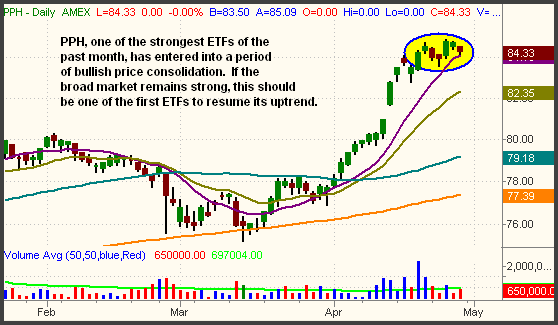
One of the strongest sector ETFs of the past month, the Pharmaceutical HOLDR (PPH), has begun a period of bullish price consolidation. Its 10-day moving average caught up to it last Friday, though the 20-day EMA is still well below. As this sector has had among the most relative strength of any, watch for further consolidation and a subsequent resumption of the uptrend in the coming week:
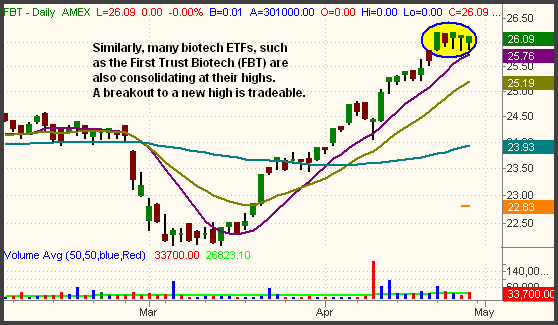
Similarly, the First Trust Biotechnology (FBT) has been in a tight range for the past week and should see a continuation of new highs if the broad market remains strong. The Biotech HOLDR (BBH) is more well-known than the offering from First Trust, but the latter has much more relative strength. BBH is still trading below its prior highs from January and February, whereas FBT is at a record high:
The Dow wrapped up last week at an all-time high, while both the S&P and Nasdaq closed at nearly 7-year highs. As such, there is technically a lack of overhead supply to hold them down. With no significant levels of horizontal price resistance, it doesn't take a lot of buying pressure to enable these indices to move higher. However, the small-cap Russell 2000 is one index that is not confirming all the bullishness. As you can see on the daily chart below, the Russell is having trouble breaking out above its prior highs from February:
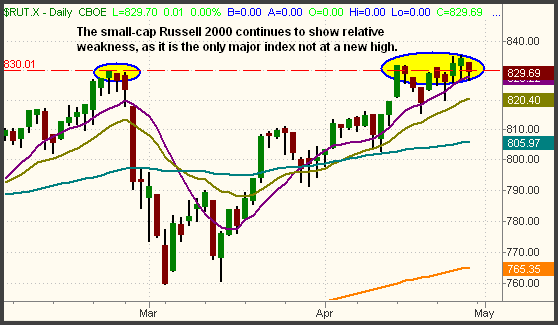
Although the financial media rarely discusses the movement of the Russell 2000 Index, its performance is quite important. Small-cap stocks that comprise the Russell often lead bull markets because they are the aggressive growth stocks that are more speculative in nature. Obviously, a bull market can be driven by large-cap blue chips instead, but they are historically shorter-lived because they are slow-moving giants. We'll be paying attention to the action in the Russell over the next few days, as a clear breakout to a new high would enable the other major indices to continue their bull runs much easier.
Last week, we mentioned that at least a short-term broad market correction was required in order to give new trade entries a positive risk/reward ratio. However, corrections do not always require a pullback in price. When a market is strong, corrections by time are often more common. A "correction by time" occurs when the major indices trade in an orderly, sideways manner for a period of a week or more. This enables moving averages, such as the 20-day MA, to rise up to meet the price of the market.
Corrections by time accomplish the same thing as price retracements, in that the key moving averages eventually provide support. However, this type of sideways consolidation is more bullish than a pullback because institutions are not even taking the chance to sell into strength. Rather, they are merely taking a break from accumulating stocks. Since the last two days of trading have been narrow-range days with barely changed prices, it appears as though the S&P may have begun a "correction by time." If this action continues for the next several days, the 20-day exponential moving average will quickly begin to "catch up" to the price of the S&P. Presently, the index is still pretty extended above the 20-day EMA (by 52 points), but we would certainly be much more comfortable with entering new long positions when the S&P eventually touches its 20-day EMA, either through further price consolidation or a normal pullback.
Deron Wagner is the Founder and Head Trader of both Morpheus Capital LP, a U.S. hedge fund, and Morpheus Trading Group, a trader education firm launched in 2001 that provides daily technical analysis of the leading ETFs and stocks. For a free trial to the full version of The Wagner Daily or to learn about Wagner's other services, visit MorpheusTrading.com or send an e-mail to deron@morpheustrading.com.
|



 Free Festival of Traders Videos


