A negative reaction to Intel's quarterly earnings report triggered a selloff in the tech sectors and the Nasdaq, but the rest of the major indices were little changed. The Nasdaq Composite managed to trade in a sideways range throughout the first half of the day, but sellers took control in the afternoon, causing the index to close 0.7% lower. The S&P 500 showed relative strength by giving up an early gain to lose only 0.1%. The small-cap Russell 2000 fell 0.3%, but both the Dow Jones Industrial Average and the S&P Midcap 400 indices were unchanged. Each of the major indices finished in the bottom third of their intraday ranges.
Turnover marginally increased in both exchanges, causing the Nasdaq to register a bearish "distribution day." Total volume in the NYSE increased by 1%, while volume in the Nasdaq was 5% higher than the previous day's level. The 0.7% decline on 5% greater volume was indicative of institutional selling, but it was only the Nasdaq's second "distribution day" within the past four weeks. Even healthy markets will occasionally see a day or two of institutional selling, but four or more such "distribution days" within a four week period will usually lead to bearish trend reversals. As such, we will be on the lookout for any additional sessions of higher volume selling that occur in the coming days. Like the price divergence in the major indices, market internals were mixed as well. Advancing volume in the NYSE exceeded declining volume by a margin of 1.2 to 1, but the Nasdaq ratio was negative by nearly 3 to 1.
In the first two weeks of the new year, the Nasdaq showed major relative strength to the S&P and Dow by rapidly breaking out to a fresh six-year high. But we also warned that corporate earnings season has a bad habit of ruining solid technical chart patterns. On January 10, for example, the Semiconductor Index ($SOX) broke out above a one-year downtrend line, but Tuesday night's earnings report from Intel caused the index to give back all of its January 10 gain and then some. The $SOX closed yesterday right at support of its 20-day MA and just a bit below its 50-day MA, but it would not require a lot of selling pressure to send the index back down to its December low. If the $SOX fails to hold above yesterday's low, it could rapidly drop down to once again test support of its 200-day MA. As such, we sold half of our long position in the Semiconductor HOLDR (SMH) into strength yesterday morning in order to reduce our risk exposure. Below is a chart of the $SOX index:
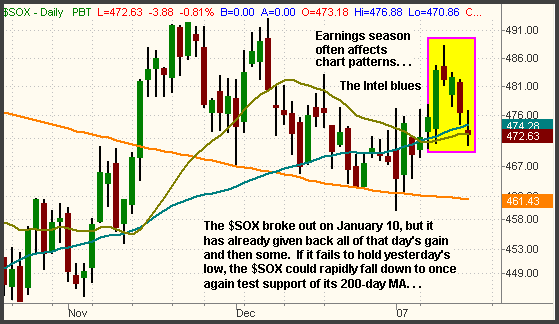
The heavily weighted $SOX index nearly always leads the Nasdaq in both directions, which is why the Nasdaq came under so much pressure yesterday. But even though the Nasdaq slid 0.7%, it is still holding above support of its multi-year breakout level. As you can see on the chart below, horizontal price support for the Nasdaq should now be found at the 2,470 level, which was resistance of its prior high:
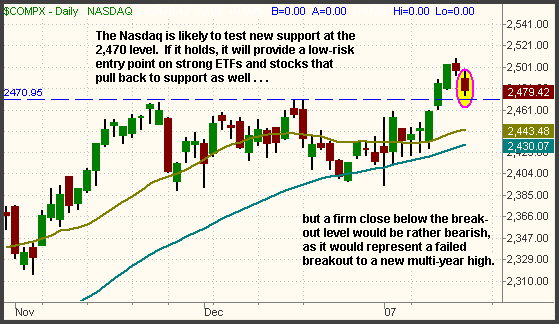
If the Nasdaq finds support at the 2,470 area in the coming days, it will confirm its recent bullishness, and could also offer low-risk entry points on strong ETFs that have pulled back to support as well. However, all bets are off on buying the tech sectors if the Nasdaq registers a firm close below 2,470. Note that intraday "stop hunts" below that level are to be expected, but the important factor is whether or not the index actually closes below support of its breakout level.
As for the S&P and the Dow, recall from the January 17 issue of The Wagner Daily that they remain at pivotal resistance of their multi-year highs. Yesterday, both indices probed to new highs on an intraday basis, but again finished the day below their respective resistance levels. The S&P Midcap 400 and Russell 2000 indices failed to test new highs yesterday, but both are still within striking distance of breaking out. The reaction to earnings reports from Apple, Merrill Lynch, Motorola, and other closely-watched companies in the coming days will determine whether the major indices "make it" or "break it" from here. Remember to trade what you see, not what you think!
Deron Wagner is the Founder and Head Trader of both Morpheus Capital LP, a U.S. hedge fund, and Morpheus Trading Group, a trader education firm launched in 2001 that provides daily technical analysis of the leading ETFs and stocks. For a free trial to the full version of The Wagner Daily or to learn about Wagner's other services, visit MorpheusTrading.com or send an e-mail to deron@morpheustrading.com.



 Free Festival of Traders Videos


