Stocks traded in a narrow, sideways range before finishing yesterday's session near the flat line and with mixed results. The S&P 500 gained 0.1% and the Dow Jones Industrial Average advanced 0.2%, but the Nasdaq Composite took a breather and declined 0.2%. The S&P Midcap 400 Index was also lower by 0.2%, while the small-cap Russell 2000 fell 0.4%. Despite the tame action in the major indices, leading stocks continued to show overall relative strength. Volatility in the broad market was a bit subdued ahead of earnings reports by keystone companies such as Intel, which reported after yesterday's close.
Total volume in the NYSE declined by 2%, but volume in the Nasdaq was 3% higher than the previous day's level. Although the Nasdaq fell on higher volume, both the minimal volume increase and small percentage drop were not enough to technically register a bearish "distribution day." After five straight days of gains, it was more representative of a normal consolidation instead. Both the S&P and Dow closed higher, but market internals in the NYSE were fractionally negative, as declining volume in the NYSE exceeded advancing volume by 1.1. The Nasdaq was negative by the same ratio.
Of all the major indices we follow, both the Nasdaq Composite and Nasdaq 100 indices are the only ones that have firmly broken out to new multi-year highs. However, many of the other indices have begun to test resistance of their prior highs as well. Beginning with the S&P 500 SPDR (SPY), let's take a look at how many of the broad-based ETFs are now testing pivotal resistance levels:
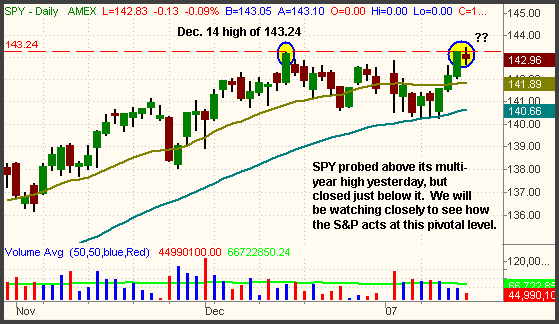
The multi-year intraday high on SPY is 143.24 and was set on December 14. Yesterday, SPY traded 20 cents above that level, but closed just below it. Over the next few days, many traders will be focused on whether or not SPY (and the S&P 500) is able to convincingly break out to a new multi-year high. If it does, it will confirm the strength in the Nasdaq, but inability to overcome that resistance level could rapidly send SPY back down to test its 50-day moving average. If it comes back down to its 50-MA only a few days after bouncing off it, the odds of a breakdown below the 50-MA would be much greater.
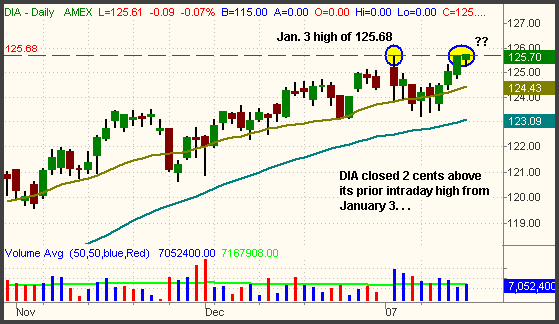
The DIAMONDS (DIA), which mirrors the Dow Jones Industrial Average, is similarly testing resistance of its multi-year high. As you can see on the chart below, DIA closed just two cents above resistance of its prior intraday high that was set on January 3. Because the Dow only consists of thirty blue-chip stocks, it is not as representative of the stock market's health as the broad-based S&P 500, but the media and general public nevertheless place a lot of emphasis on the state of the Dow. As such, it remains an important indicator of sentiment:
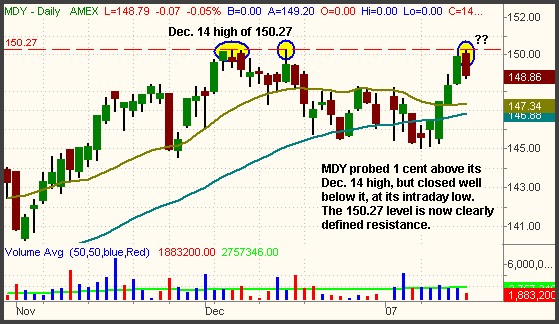
The S&P Midcap SPDR (MDY) was another broad-based ETF that tested resistance of its multi-year high yesterday. On December 14, MDY traded up to an intraday high of 150.27, an all-time high for this ETF. Yesterday morning, MDY traded exactly one cent above that level, then drifted lower throughout the remainder of the session. Because the S&P Midcap 400 is typically an accurate barometer of the broad market's health, keep an eye on that prior high from December 14 over the next few days:
Curiously, the small-cap Russell 2000 has been showing the most relative weakness in the new year. Over the past several years, the Russell has led most bull markets, but we have been seeing bearish divergence over the past few weeks. The iShares Russell 2000 (IWM) recovered back above its 50-day MA only three days ago, but yesterday's intraday high came within striking distance of its prior highs from last month:
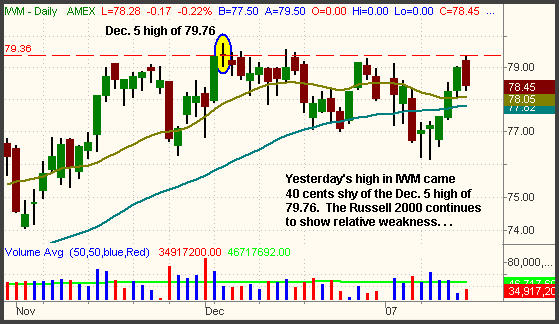
A firm rally in IWM above yesterday's high would be not only bullish for the Russell 2000 index, but for the entire broad market as well. However, it would not take a lot of selling pressure to push IWM back below its 50-day MA.
As you can see, many of the major indices are once again at pivotal "make it or break it" levels. If the above indices can manage to close solidly above yesterday's highs, it will be a positive sign that confirms the Nasdaq's breakout. But, like we mentioned yesterday, the determining factor is going to be the market's reaction to the important earnings reports in the coming days. Stay cautious and nimble and you'll be okay.
Deron Wagner is the Founder and Head Trader of both Morpheus Capital LP, a U.S. hedge fund, and Morpheus Trading Group, a trader education firm launched in 2001 that provides daily technical analysis of the leading ETFs and stocks. For a free trial to the full version of The Wagner Daily or to learn about Wagner's other services, visit MorpheusTrading.com or send an e-mail to deron@morpheustrading.com.



 Free Festival of Traders Videos


