The broad market gapped significantly higher last Friday morning, but subsequently drifted lower throughout the day before finishing with mixed results. At the open, the Nasdaq Composite was trading 0.7% higher, but it closed with a gain of only 0.1%. Both the S&P 500 and Dow Jones Industrial Average also fell from their highs, but advanced 0.1% and 0.2% respectively. Small and mid-caps showed relative weakness. The Russell 2000 Index lost 0.2% and the S&P Midcap 400 closed 0.3% lower. With the exception of the Dow, each of the major indices finished near their intraday lows. The Dow closed just below the middle of its range.
Turnover spiked substantially in Friday's session, but much of the volume increase could be attributed to "quadruple witching" options expiration. Total volume in the NYSE increased by 34%, while volume in the Nasdaq was 25% higher than the previous day's level. On the third Friday of the last month of each calendar quarter, options contracts for stock index futures, stock index options, stock options and single stock futures (SSF) all simultaneously expire. This typically results in a volume surge as traders and investors adjust their corresponding stock positions. Because much of Friday's increase in volume was attributed to "quadruple witching," it is difficult to ascertain whether stocks were being accumulated or distributed. In the Nasdaq, advancing volume exceeded declining volume by a margin of nearly 2 to 1, but the NYSE ratio was marginally negative.
In our last newsletter, we showed how the Oil Service HOLDR (OIH) had broken out of its consolidation last Thursday. It followed up with a session of consolidation on Friday, so it continues to look good for further upside. We also pointed out the potential entry points that were setting up in both the CurrencyShares Euro Trust (FXE) and the Market Vectors Gold Miners (GDX). In Friday's session, both ETFs moved lower, but that's okay because they never triggered for entry. We mentioned that buying either one without first waiting for a rally above the previous day's high would be risky because they could continue to drift lower before finding support and resuming their uptrends. GDX gapped open above its high of the previous day, but only by nine cents. As you know, we always require a stock or ETF to trade at least 10 to 15 cents above a pivot before entering. GDX never did. Still, we continue to like both ETFs for potential entry in the coming week. We'll be keeping an eye on their performance and will send an intraday e-mail alert to subscribers if/when we enter either of them. On the downside, the Transportation sector (and IYT) continues to display relative weakness and a topping chart pattern.
Both the S&P 500 and Dow Jones Industrial Average concluded last week at new six-year highs, but several key indexes have run into key resistance levels. Perhaps the biggest concern for bulls should be the lagging Nasdaq Composite Index. As illustrated on the daily chart below, the prior high of 2,468 that was set on November 24 has become a pivotal resistance level:
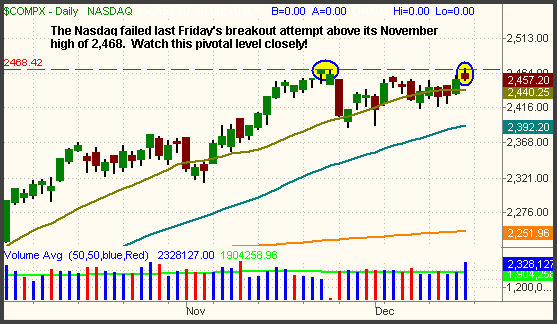
On Friday morning, the Nasdaq probed above its November 24 high by trading up to 2,470, but the breakout attempt immediately failed, causing the index to close below its previous day's high. Going into today, traders and investors will be focused on whether or not the Nasdaq can break out and hold above the 2,468 to 2,470 area. If it can, it will help to confirm the new highs in the S&P and Dow, but an inability to follow suit by moving to a fresh high will likely put the S&P and Dow breakouts in jeopardy. One determining factor will be the direction of the Semiconductor Index ($SOX). Recall that we illustrated in the November 15 issue of The Wagner Daily how the $SOX remains stuck in "no man's land."
It's not only the Nasdaq that is showing relative weakness to the S&P and Dow. Both the small-cap Russell 2000 and S&P Midcap 400 indices are also having trouble with the overhead supply from their prior highs. Take a look:
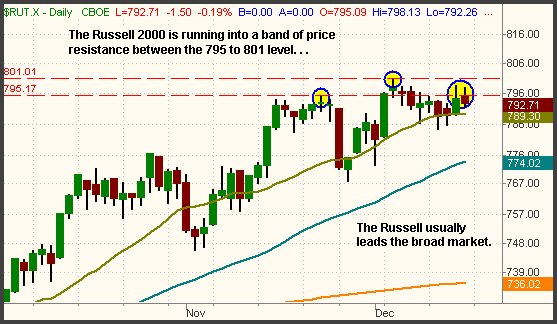
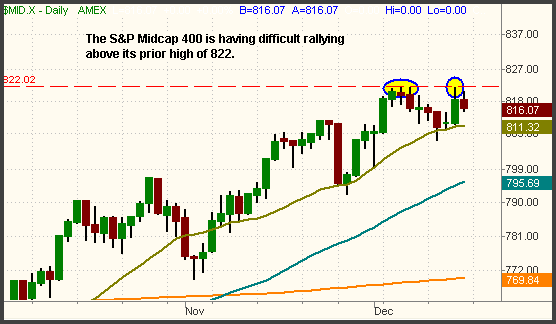
In the Russell, there is a band of horizontal price resistance between the 795 to 801 area. In the S&P Midcap, 822 is the magic number that the index must overcome. Not surprisingly, the talking heads of the financial media spend minimal time discussing the performances of both these indexes. Instead, they typically focus on the "Big 3" of the benchmark S&P 500, Dow, and Nasdaq. Since the Russell and S&P Midcap indexes usually outperform and lead the broad market in both directions, it is ironic they are rarely given the analysis they deserve. We would even go as far as to say that, over the past several years, the Russell 2000 has become a more accurate barometer of the stock market's health than the $SOX index. When combined with the Nasdaq's resistance, we anticipate that a failed breakout in either the Russell or S&P Midcap will begin to attract the interest of the bears. Nevertheless, it remains risky to be aggressively short right now because the S&P and Dow are both at new highs. Remember to trade what you see, not what you think!
Deron Wagner is the Founder and Head Trader of both Morpheus Capital LP, a U.S. hedge fund, and Morpheus Trading Group, a trader education firm launched in 2001 that provides daily technical analysis of the leading ETFs and stocks. For a free trial to the full version of The Wagner Daily or to learn about Wagner's other services, visit MorpheusTrading.com or send an e-mail to deron@morpheustrading.com.



 Free Festival of Traders Videos


