Stocks gapped higher on yesterday's open, but traders immediately sold into strength, causing the major indices to fall to unchanged levels within the first hour of trading. After chopping around throughout mid-day, the broad market followed through on the opening weakness, causing stocks to break down to new intraday lows. The Nasdaq Composite led the way lower with a 0.7% loss. The S&P 500 and S&P Midcap 400 indices both fell 0.4%, while the Dow Jones Industrial Average slid 0.3%. The small-cap Russell 2000 declined by 0.5%. Each of the major indices closed near their worst levels of the day.

Total volume in the NYSE declined by 6%, but volume in the Nasdaq was 8% higher than the previous day's level. The mixed turnover readings caused the Nasdaq to register a bearish "distribution day," its third within the past four weeks. The S&P, however, not only showed more relative strength during the session, but also declined on lighter volume. Yesterday's Nasdaq volume was the highest it has been since November 15. This tells us that institutions may be returning to the markets, but on the sell side. The action was a good example of why we have been advising "sitting on hands" and a mostly cash position over the past few days. Simply put, buying stocks in a light volume environment is tricky, especially when stocks are sitting at their highs of a multi-month uptrend. Market internals were negative in both exchanges. In the NYSE, declining volume exceeded advancing volume by a margin of 1.7 to 1. The Nasdaq ratio was negative by 1.9 to 1.
In addition to the Oil and Oil Service sectors, which we still like due to their "bull flag" chart formations, it also appears that the Gold Index ($GOX) is poised to head back up after a brief correction. On December 1, we sold our long position in the StreetTRACKS Gold Trust (GLD) for a substantial profit because it was nearing resistance of its August high and we anticipated a correction. As expected, the downward retracement began one day later, but yesterday's price action leads us to believe that the correction will be short-lived. On the chart below, notice how GLD sold off sharply in the morning, but recovered to close at its intraday high. Such price action formed a bullish "hammer" candlestick pattern in the process:
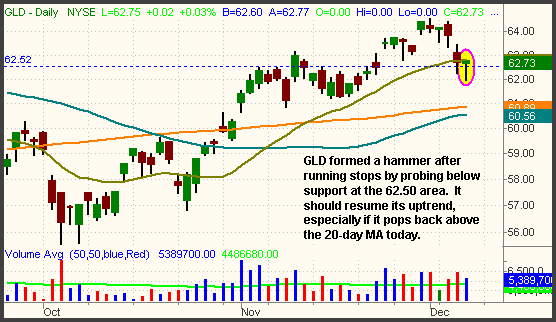
Since gold often moves contrary to the direction of the U.S. dollar, the recent breakout and strength in the Euro should also enable GLD to bounce back to its highs quickly. There is solid price support near yesterday's low, so it is relatively low risk to buy GLD here and place a stop below yesterday's low. One could even put their stop below the 50 and 200-day moving averages, just as long as share size was reduced in order to allow for the additional risk of a wider stop. Note that the iShares Silver Trust (SLV) is displaying a similar chart pattern and has even more relative strength than GLD. The Market Vectors Gold Miners (GDX) tracks the price of gold mining stocks, as opposed to the spot gold commodity, but it looks pretty good too.
Although the S&P 500 SPDR (SPY) is still near its six-year high, the Nasdaq 100 Tracking Stock (QQQQ) appears to have formed a "lower high" within the context of its primary uptrend line. Most likely, this will result in a break below the lower channel of its four-month uptrend line that is closed at yesterday. If that happens, the index should at least test support of its "swing low" that was formed on December 1. This is illustrated on the daily chart of QQQQ below:
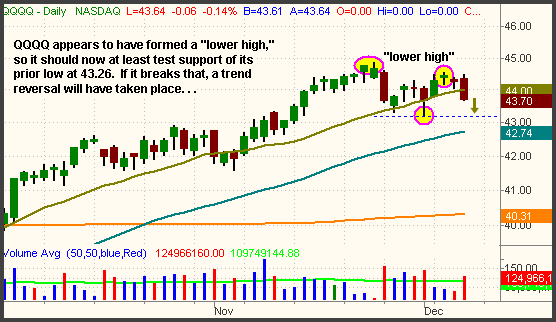
If the December 1 low fails to hold, QQQQ will have formed its first "lower high" and "lower low," indicating a short to intermediate-term trend reversal. At the very least, a break below its prior low of 43.26 should lead to a test of the 50-day moving average, presently at 42.74. Beyond that, a retracement to near the November 3 low of 41.61 is not unrealistic. QQQQ obviously needs to form a "lower low" first, but yesterday's bearish pattern increases the likelihood of at least testing that low before attempting to move higher. Because of the Nasdaq's decisive move, we shifted out of "SOH mode" to "dip a toe in the water" with regard to trading the broad-based ETFs. Per intraday e-mail alert to subscribers, we bought the UltraShort QQQ ProShares (QID) when it broke out above its 20-day moving average. Like all the other UltraShort ProShares funds, QID is inversely correlated to the price of the Nasdaq 100, and at a 2 to 1 ratio. As of the close, the position is showing a marked-to-market gain of just under 1%.
Deron Wagner is the Founder and Head Trader of both Morpheus Capital LP, a U.S. hedge fund, and Morpheus Trading Group, a trader education firm launched in 2001 that provides daily technical analysis of the leading ETFs and stocks. For a free trial to the full version of The Wagner Daily or to learn about Wagner's other services, visit MorpheusTrading.com or send an e-mail to deron@morpheustrading.com.



 Free Festival of Traders Videos


