The major indices posted solid gains across the board yesterday, but lower turnover failed to confirm the positive price action. Nevertheless, the Nasdaq Composite followed through on last Friday afternoon's bullish reversal by cruising 1.5% higher, while the small-cap Russell 2000 Index led the way with a 1.9% gain. The S&P Midcap 400 maintained a similar pace by advancing 1.2%. Gains were a bit more subdued in the S&P 500 and Dow Jones Industrial Average, which rallied 0.9% and 0.7% respectively. Stocks lazily fell from their highs in the late afternoon, but each of the major indices still finished in the upper third of their intraday ranges.

Just as lighter volume enabled the broad market to avert a bearish "distribution day" last Friday, even lower overall volume prevented both the S&P and Nasdaq from registering a bullish "accumulation day" yesterday. Total volume in the Nasdaq declined by only 1%, but volume in the NYSE was 19% lower than the previous day's level. Given the relatively high percentage gains in the major indices, one might have expected a corresponding increase in turnover. But institutional traders stood on the sidelines, even more so than they did during last Friday's selloff. The lack of participation by hedge funds, mutual funds, and other institutions caused volume in the NYSE to fall below its 50-day average level for the first time in six sessions. The Nasdaq barely exceeded its average turnover. Despite the lower volume, market internals were pretty good. In the Nasdaq, advancing volume exceeded declining volume by more than 4 to 1. The NYSE ratio was positive by 3 to 1.
In yesterday's The Wagner Daily, we said our short-term bias would remain bearish unless the major indices closed above their respective November 30 highs, which is exactly what happened. The S&P 500, Nasdaq Composite, and Dow Jones Industrial Average each finished just above the pivotal resistance levels we illustrated yesterday morning. The S&P 500 actually finished at a new six-year high yesterday, but the Nasdaq and Dow both remain below their prior highs from last month. The recovery from the November 27 selloff has pushed both the S&P and Nasdaq back above the lower channel support of their primary uptrend lines from the July lows, but the Dow continues to show relative weakness. As you can see on the chart below, prior support of the Dow's uptrend line has now become its new resistance level:
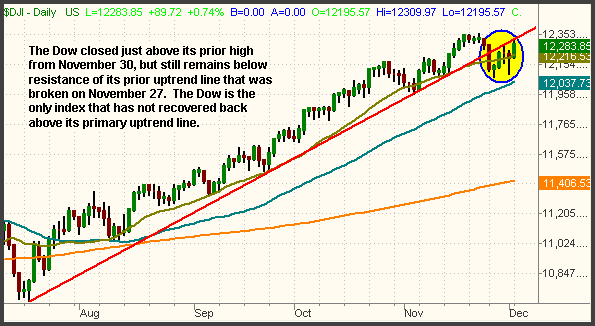
Since the market immediately began giving mixed signals after the November 27 selloff, we tightened our stop in the UltraShort Dow 30 ProShares (DXD) in order to greatly reduce our risk. When the Dow moved above its November 30 high yesterday, our long position in DXD hit its trailing stop, but the loss was only 36 cents. The DXD trade could still work out if the Dow continues to fail at its prior uptrend line, but we can always re-enter the trade with less risk.
Unexpected merger and acquisition activity in the banking arena triggered a sector-specific rally that put pressure on our short position in the Regional Bank HOLDR (RKH), but it missed our stop by a few cents before backing off into the close. As for the retail ETFs we were stalking on the short side, all bets are off because the Retail Index ($RLX) rallied in sync with the broad market and never broke down below its 50-day moving average.
Right now, we really don't like the overall price and volume action we see in the broad market. Specifically, the stock market has made substantial price moves in both directions over the past two days, but has done so on declining volume each time. It was positive that volume declined when stocks fell last Friday, but negative that they followed up with a strong session of gains on even lower turnover. When this type of action occurs, it is often an early warning sign that institutions are backing away from the market, leaving the retail investors to battle it out amongst themselves. Unfortunately, this usually leads to choppy and erratic trading action that is plagued by both false breakouts above resistance levels and breakdowns below support levels. Simply put, the buying power of institutions is required in order to sustain steady trends. Without it, short-term traders can easily churn their accounts. For that reason, we are shifting into SOH mode ("sitting on hands") until the market decides with conviction the direction of its next major move. Capital preservation is key when the market is giving mixed signals at pivotal levels.
Deron Wagner is the Founder and Head Trader of both Morpheus Capital LP, a U.S. hedge fund, and Morpheus Trading Group, a trader education firm launched in 2001 that provides daily technical analysis of the leading ETFs and stocks. For a free trial to the full version of The Wagner Daily or to learn about Wagner's other services, visit MorpheusTrading.com or send an e-mail to deron@morpheustrading.com.



 Free Festival of Traders Videos


