As anticipated, the Semiconductor Index ($SOX) finally broke out above its two-month sideways range yesterday, pulling the major indices to new multi-year highs as well. The $SOX surged 2.8% and busted through its 200-day moving average, enabling the Nasdaq to zoom 1.0% higher as well. The S&P 500 and Dow Jones Industrial Average both kept pace pretty well, closing higher by 0.6% and 0.7% respectively. The small-cap Russell 2000 galloped to a 1.6% gain, while the S&P Midcap 400 Index advanced 1.0%. All of the major indices closed at their intraday highs, indicating decisive trading action into the close this time.
Volume spiked higher in both exchanges yesterday, confirming the bullish action. In the NYSE, total volume was an impressive 22% higher than the previous day's level. Total volume in the Nasdaq rose by 12%. The solid gains on higher volume caused both the S&P and Nasdaq to register bullish "accumulation days." Clearly, yesterday's broad-based rally was supported by institutional buying. This is important because it increased the odds that the market will retain its gains. Not surprisingly, market internals were strong across the board. Advancing volume in the NYSE exceeded declining volume by a margin of 3 to 1. The Nasdaq ratio was similarly positive by 2.7 to 1.
The $SOX closed back above its 200-day MA for the first time since May 11. It also closed at its highest price since May 19. Whereas the sector has traded erratically in a non-committal manner over the past two months, we are definitely seeing positive money flow into the sector now. Yesterday's technical breakout should also generate further upside momentum in the coming weeks. Since there are several ETFs that track the index, it's important to make sure you buy the one with the most relative strength. Using a "percentage change" chart to compare the gains of each ETF relative to one another is a quick and efficient way to weed out those that are lagging, but it's also important to compare resistance levels on their daily charts because not all the semiconductor ETFs have the same pattern right now. To illustrate this, compare the charts below. The first is the well-known Semiconductor HOLDR (SMH) and the second is the lesser-known StreetTRACKS SPDR Semiconductor (XSD):
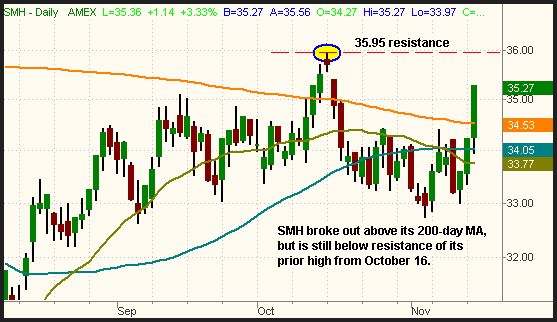
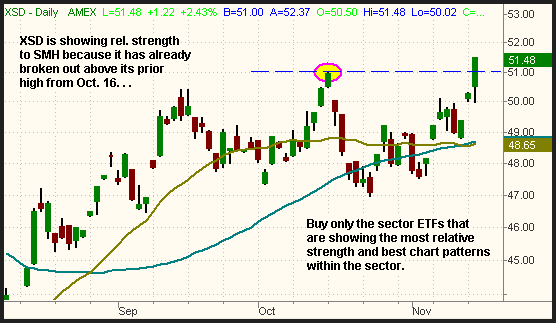
In the first chart, it is bullish that SMH broke out above its 200-day moving average, but notice that it still remains below its prior high from October 16. Both the iShares Semiconductor (IGW) and the PowerShares Semiconductor (PSI) also failed to break out above their prior highs from last month. Conversely, XSD (the second chart) is the only one of the semiconductor ETFs that has already broken out above resistance of its prior high. The relative strength in XSD is, of course, the result of a different composition of the underlying stocks that comprise the ETF. Before entering a new trade in any sector, you should always be sure the ETF family you are considering is the strongest one in the sector because its gains will usually outperform on the "up" days, while its losses should be less on the "down" days.
Yesterday, the S&P, Dow, and Nasdaq each closed firmly at new multi-year highs. The S&P finished at its highest level in six years, the Dow printed a new record high, and the Nasdaq secured its highest closing price since February of 2001. With no prior highs to provide overhead supply of traders and investors selling into strength, there is obviously a lack of any technically significant resistance points right now. Until that situation changes, you should be focused on the long side of the market and avoid any new short positions. Just as a stream running down a hill will always follow the path of least resistance by flowing around any rocks or debris, so does the stock market. When indices, stocks, or ETFs are at new highs, it doesn't require a lot of buying pressure to make them go higher because there is even less selling pressure to hold them down. Astute traders always trade what they see, not what they think. Therefore, it is completely relevant whether or! not you feel the new highs are justified. Fighting the reality of the trend only causes missed opportunities and unnecessary losses.
Deron Wagner is the Founder and Head Trader of both Morpheus Capital LP, a U.S. hedge fund, and Morpheus Trading Group, a trader education firm launched in 2001 that provides daily technical analysis of the leading ETFs and stocks. For a free trial to the full version of The Wagner Daily or to learn about Wagner's other services, visit MorpheusTrading.com or send an e-mail to deron@morpheustrading.com.



 Free Festival of Traders Videos


