The stock market drifted lower throughout last Friday's session, but lighter volume softened the blow. Not surprisingly, small and mid-cap stocks maintained their pattern of relative weakness. The Russell 2000 Index fell 1.1% and the S&P Midcap 400 declined 0.9%. The Nasdaq Composite lost 0.7%, the S&P 500 0.4%, and the Dow Jones Industrial Average 0.3%. Each of the major indices oscillated within their respective trading ranges of the previous day, meaning not much changed on a technical level. A modest wave of buying late in the afternoon lifted the broad market off its intraday lows.
Volume again declined in both exchanges, but this time the lower turnover was positive because it coincided with broad-based losses in the market. In the NYSE, total volume declined by 17%, while volume in the Nasdaq was 18% lighter than the previous day's level. Unlike a majority of recent "down" days in the market, lighter volume this time indicated that institutions were not aggressively selling. Instead, the losses were more the result of a lack of strong buying interest. As we often see in the month of August, volume levels have been pretty lethargic over the past several weeks. Friday's session saw the least number of shares change hands in more than a month, but many traders and investors have begun to take their annual summer vacations.
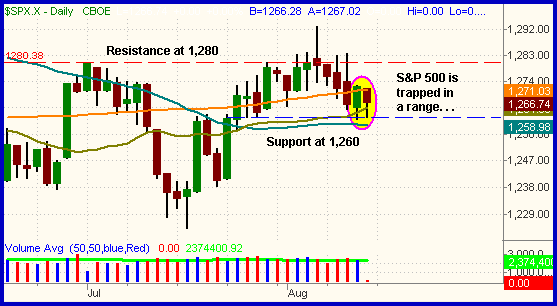
The S&P 500 declined 1% last week, but the loss did little to change the overall technical picture of the broad market. Throughout the past four days, the 200-day moving average has acted like a magnet for the index, which has alternated between closing just above or below that pivotal level. The S&P closed the week below its 200-MA, but support of both the 20 and 50-day moving averages is right underneath last week's closing price. Throw in the fact that volume is likely to remain light for the next several weeks and you've got strong odds that the market will chop around in a sideways range in the short-term. As the chart below illustrates, the S&P has been stuck in a range from the area of 1,260 to just over 1,280. Until the index firmly closes above or below that range, we are taking it easy with entering new positions:
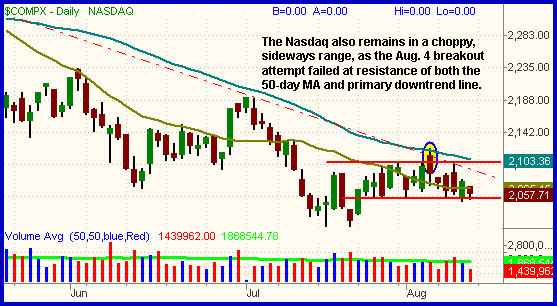
The Nasdaq Composite has similarly been trading in a tight range from around 2,050 up to 2,098. On August 4, the Nasdaq broke out above that range on an intraday basis, but overhead resistance of its 50-day moving average caused the index to sell off and close back within its prior range. Looking at the daily chart of the Nasdaq, notice how the 50-day moving average has converged with its primary downtrend line for quite some time. Obviously, there is no point buying tech stocks and ETFs until the Nasdaq eventually breaks out above that confluence of resistance. Price confirmation would occur from a closing price above the August 4 high, while a rally on stronger volume would confirm the return of institutional accumulation:
Presently, both the S&P and Nasdaq cash futures are pointing to significantly higher opening prices. The cease-fire between Hezbollah fighters and Israeli troops in Lebanon has likely been a contributing factor to this, but the big question is whether or not stocks will retain their gains throughout the day. Most opening gaps over the past several months have failed, as traders have used the higher prices as a chance to sell into strength. However, we do not recommend aggressively selling short into today's gap unless the major indices clearly show an inability to sustain their opening gap prices. Now is probably a good time to simply focus on managing existing positions and building a new watchlist of stocks and ETFs for potential entry on both sides of the market. Doing so will enable you to be prepared when the S&P and Nasdaq finally break out of their recent ranges, though this may not occur until after the summer doldrums have passed.
Deron Wagner is the Founder and Head Trader of both Morpheus Capital LP, a U.S. hedge fund, and Morpheus Trading Group, a trader education firm launched in 2001 that provides daily technical analysis of the leading ETFs and stocks. For a free trial to the full version of The Wagner Daily or to learn about Wagner's other services, visit MorpheusTrading.com or send an e-mail to deron@morpheustrading.com.



 Free Festival of Traders Videos


