The broad market chopped around in a sideways range throughout most of yesterday's session, but buyers stepped in during the final ninety minutes of trading and lifted most stocks into positive territory. Both the S&P 500 and Nasdaq Composite gained 0.6%, while the Dow Jones Industrial Average advanced 0.5%. Small and mid-cap stocks showed relative weakness again, as the Russell 2000 and S&P Midcap 400 indices eked gains of 0.2% and 0.1% respectively. Each of the major indices finished at their intraday highs and the S&P 500 even recovered a majority of the previous day's loss. The Nasdaq, however, only retraced approximately one-third of its prior day's drop. Blame that on the Semiconductor Index ($SOX), which lost another 0.6% and closed at a fresh seven-month low.
Lower turnover across the board prevented the broad market from registering a bullish "accumulation day" yesterday. Total volume in the NYSe declined by 2%, while volume in the Nasdaq was 10% lighter than the previous day's level. From June 16 through 23, the price to volume ratios in the market were positive overall. During that period, the S&P 500 had five days of losses and one day of gains, but each of the "down" days were on lighter volume, while the "up" day was on higher volume. However, the market has not been performing as well "under the hood" since then. The S&P 500 has closed higher in two of the past three sessions, but it did so on lighter volume. Conversely, the sole "down" day was on higher volume, indicating institutional selling. The volume patterns have turned negative over the past several days, but it is important to note that turnover in both exchanges has come in below the 50-day average levels in each of the past eight days. The lighter than average volume levels may be concealing the true intentions of the "smart money," but we will likely see a spike in volume after this afternoon's FOMC announcement on interest rates. The direction of the broad market during the next volume spike will help us to determine the direction in which stocks will mostly likely trade in the near-term.
Over the past several days, we have pointed out three different ETFs that were showing relative strength or setting up for potential long entries. Those ETFs were the United States Oil Fund (USO), the iShares Xinhua China 25 Fund (FXI), and the iShares Mexico Fund (EWW). As of yesterday's close, both USO and FXI continue to act well, while EWW remains in a trading range. Steadily rising crude oil prices over the past two weeks have enabled USO to break out above its secondary downtrend line that had been in place since the high of May 2. However, it still must overcome resistance of its primary downtrend line just above that. Its recent double bottom should help to generate some upside momentum:
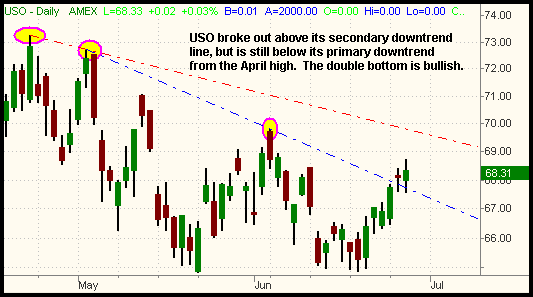
Unfortunately, strong technical patterns in USO are sometimes rendered irrelevant due to geopolitical news and speculation coming out of the Middle East. Nevertheless, the breakout above its secondary two-month downtrend line is bullish and should at least lead to a probe above the primary downtrend line, perhaps more. If you take a shot at USO on the long side, consider placing a protective stop just below the prior downtrend line. Remember that prior resistance acts as the new support level after the resistance is broken.
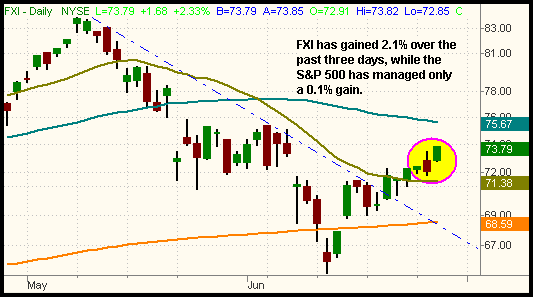
While the S&P 500 has rallied only 0.1% over the past three days, FXI has actually gained 2.1%. We mentioned the relative strength and break of FXI's downtrend line in the June 26 issue of The Wagner Daily and it has steadily moved higher since then. If you're currently long FXI and are only interested in a short-term play, consider selling into strength near the 50-day moving average, presently at 75.67:
Expect a lot of volatility in the final hours of today's session. The Federal Reserve Board will announce their decision on interest rates at 2:15 pm EDT, and whipsaw action in both directions is expected after that time. As mentioned yesterday, we continue to avoid entering new ETF positions ahead of the Fed announcement. However, we are considering several ETFs on both the long and short side of the market, depending on how the market reacts to the interest rate announcement. The unbiased technical picture is that each of the major indices remain below resistance of their seven-week downtrend lines, so odds obviously favor lower prices. But a shock from the Feds could easily invalidate the technicals. Stay alert and don't fall in love with your opinions. The actual facts of the interest rate announcement are irrelevant; all that matters is the market's reaction to the announcement.
Deron Wagner is the Founder and Head Trader of both Morpheus Capital LP, a U.S. hedge fund, and Morpheus Trading Group, a trader education firm launched in 2001 that provides daily technical analysis of the leading ETFs and stocks. For a free trial to the full version of The Wagner Daily or to learn about Wagner's other services, visit MorpheusTrading.com or send an e-mail to deron@morpheustrading.com.



 Free Festival of Traders Videos


