The equities markets suffered a broad-based round of losses yesterday, as traders took their cue to sell into resistance of the primary downtrend lines of both the S&P 500 and Nasdaq Composite. The Nasdaq maintained its relative weakness from Monday and fell 1.6%. The small-cap Russell 2000 registered a similar loss of 1.7%. Both the S&P 500 and S&P Midcap 400 indices declined 0.9%, while the Dow Jones Industrial Average closed 1.1% lower. The major indices broke their five-day pattern of choppy and indecisive intraday action, as stocks trended steadily lower from the open through the close. Each of the major indices finished at their lowest levels of the day.
Volume picked up yesterday, causing both the S&P 500 and Nasdaq Composite to register bearish "distribution days." Total volume in the Nasdaq surged 29% higher, while volume in the NYSE was 16% higher than the previous day's level. However, despite the increase, note that turnover in both exchanges still came in below average levels. It has been eight days since volume in either the NYSE or Nasdaq exceeded its 50-day average level. Not surprisingly, market internals were firmly negative. In the Nasdaq, declining volume exceeded advancing volume by a margin of more than 7 to 1. The NYSE ratio was negative by 4 to 1.
One sector that weighed heavily on the broad market yesterday was the Semiconductor Index ($SOX), which plummeted 3.8% and closed at its lowest level since November 1, 2005. Semiconductor stocks comprise a very large percentage of the Nasdaq, so the Nasdaq typically follows the direction of the $SOX. If this is the case, one could infer that the Nasdaq will soon break down below its "swing low" of June 14 as well:
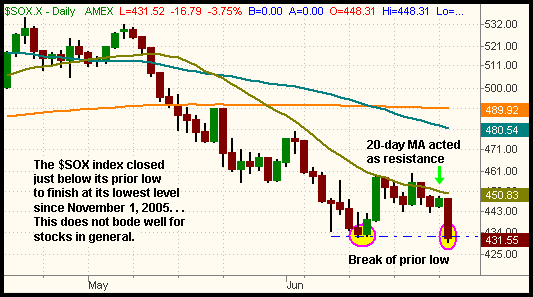
Although the $SOX itself broke down below its prior low yesterday, none of the semiconductor ETFs did so -- yet. The most popular of these ETFs, the Semiconductor HOLDR (SMH), finished 1% above its June 13 low. The other three semiconductor ETFs are: iShares (IGW), PowerShares (PSI), and StreetTRACKS (XSD). All three are just above their prior lows, but could easily gather a lot of downside momentum with any further weakness in the $SOX. If you want to gauge the overall health of the market, you need to look no further than the terrible performance of the $SOX.
Over the past several days, we have been on alert for a swift move in either direction and a volatility expansion in the broad market. That move began yesterday. With textbook precision, resistance of the downtrend lines in both the Nasdaq Composite and S&P 500 triggered the broad-based selloff. The downward move also caused both indices to close below their respective lows of June 21. As such, odds are now pretty good that the major indices will soon re-test their "swing lows" of June 14. Looking at the daily charts below, notice how the seven-week downtrend lines perfectly acted as resistance that triggered the selloff. The horizontal dashed line (in blue) marks the break of the June 21 low. This is significant because June 21 was a reversal attempt that has now technically failed:
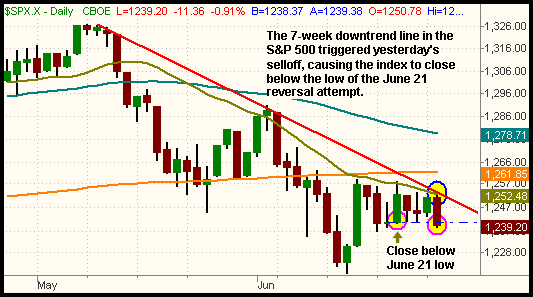
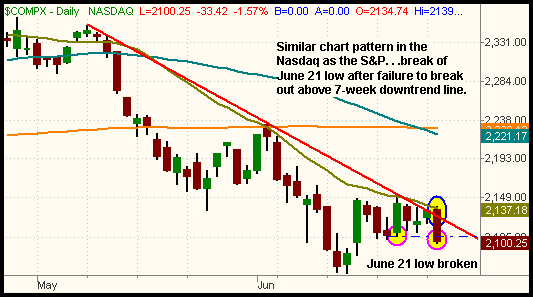
If there were no major news events forthcoming, we would feel confident about getting more aggressive on the short side, but there is one big caveat -- the Feds will announce their decision on interest rates this Thursday afternoon. As you probably already know, FOMC meetings typically result in unpredictable market volatility. Therefore, we are going to continue playing it conservatively until the Federal Reserve Board enlightens us with their decision and forward-looking commentary. Obviously, overall odds now favor the short side of the market, and it is fine to have a few open short positions. But just be prepared to act quickly if the market reacts favorably to the interest rate announcement on Thursday. Both indices are still in close proximity to their downtrend lines and the June 21 undercuts were only by a marginal amount, so don't be complacent on the short side.
Deron Wagner is the Founder and Head Trader of both Morpheus Capital LP, a U.S. hedge fund, and Morpheus Trading Group, a trader education firm launched in 2001 that provides daily technical analysis of the leading ETFs and stocks. For a free trial to the full version of The Wagner Daily or to learn about Wagner's other services, visit MorpheusTrading.com or send an e-mail to deron@morpheustrading.com.



 Free Festival of Traders Videos


