After beginning the day with an opening gap up yesterday morning, the major indices trended steadily before finishing near their intraday lows. Both the S&P 500 and Nasdaq Composite lost 0.9%, while the Dow Jones Industrial Average slid 0.7%. Small and mid-cap stocks resumed their pattern of relative weakness that began with the broad market's selloff last month. The Russell 2000 Index gave up 1.7% and the S&P Midcap 400 Index closed 1.6% lower.
The one positive of yesterday's action is that turnover declined in both exchanges. Total volume in the NYSE decreased by 24%, while volume in the Nasdaq was 30% lighter than the previous day's level. Throughout the past six weeks, a vast majority of the "down days" have been on higher volume, but the market bucked that trend yesterday. This could mean that the bears are taking at least a temporary break from their selling programs, but there is no reason to start buying stocks and ETFs until we see the lower volume losses followed up with a session of higher volume gains (aka "accumulation day"). Despite the market losing on lighter volume yesterday, market internals were still firmly negative. In the NYSE, declining volume exceeded advancing volume by a ratio of more than 4 to 1. The Nasdaq was negative by 3 to 1.
Of all the primary industry sectors we follow on a daily basis, only the Airline Index ($XAL) finished in positive territory. The $XAL gained 1.0% yesterday, but the airlines are certainly not a sector that is likely to lead the broad market out of its six-week downtrend. As a group, the oil-related stocks and ETFs suffered the worst losses yesterday. On June 14, we wrote that the Oil ($XOI) and Oil Service ($OSX) indices were looking pretty bad, as both sectors fell below support of their 200-day moving averages and primary uptrend lines on June 13. The broad market's subsequent rally on June 15 enabled many of the oil stocks to recover back above their 200-day MAs, but yesterday's 3.9% loss in the $OSX and 3.2% decline in the $XOI caused most of them to give back all of those gains and then some. That sector's inability to hold its recent gains confirms the institutional money outflow and relative weakness we initially noticed in the oil arena. As such, you may consider the energy stocks and ETFs for potential short entries in the coming week. Looking at the daily chart of the Oil Service HOLDR (OIH), notice how it promptly gave back its June 15 gain and closed right at its 200-day moving average.
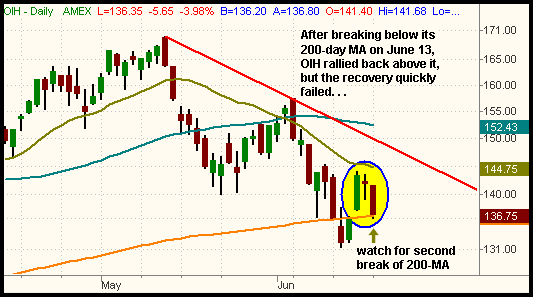
If OIH falls below its 200-day MA again, there is a good chance it will break its June 13 low. The other oil-related ETFs have similar chart patterns as well. A complete list and description of the oil ETFs can be found by downloading the free Morpheus ETF Roundup guide. Curiously, many other industry sector ETFs also rallied back above their 200-day MAs on June 15, but fell right back down yesterday. The next several days should be interesting because we could see another major round of selling if some of heavily-weighted industries fail to hold at their 200-day MAs.
In the June 12 issue of The Wagner Daily, we discussed how the DJ Real Estate Index ($DJUSRE) was one of the few sectors that was showing relative strength to the broad market's weakness. So far, this remains the case, but even the Real Estate ETFs have begun to drift back down to the lower end of their trading ranges. Notice how the iShares DJ Real Estate Index (IYR) has been trending lower since it failed its June 5 breakout:
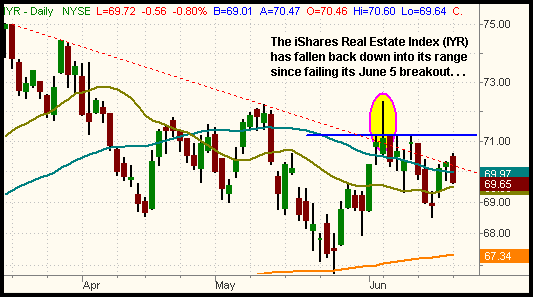
IYR is still holding up well enough that it could attempt to break out, but this is not a good environment to be buying breakouts of any kind. Nearly every strong stock that has broken out over the past several weeks only remained above its breakout level for a day or two before falling back down into the range. Based on the thousands of chart patterns we have been studying, it seems your odds of a breakout actually working are about 1 in 10. Therefore, it makes more sense to short the sectors with the most relative weakness rather than fighting the broad market's primary downtrend and attempting to go long. If you don't sell short, we strongly recommend you learn how to do so. At the very least, consider sitting in cash until there is a valid reason to begin buying stocks and ETFs again.
Technically, the reversal day from the June 15 rally is still valid because none of the major indices have violated their lows of that day. However, both the S&P 500 and Nasdaq Composite have already given back nearly two-thirds of those gains. Both the small-cap Russell 2000 and S&P Midcap 400 indices did as well. Anything more than a 61.8% Fibonacci retracement tips the odds in favor of a resumption of the prior trend rather than a trend reversal, and both the S&P and Nasdaq did that yesterday. Worse is that the S&P was not even strong enough to test overhead of its 200-day MA, which further solidifies that level of resistance. The Dow Jones retraced only half of its June 15 gains yesterday and also held above its 200-day MA, but stocks will have a difficult time making upward progress without the S&P and Nasdaq in sync with the Dow. Going into today, we remain in "wait and see" mode. If one of the major indices closes below its June 15 low, we will look to put on new short positions, but it is a bit too aggressive to do so until that happens. The fact that yesterday's losses occurred on lighter volume is another reason to be alert with short positions.
Deron Wagner is the Founder and Head Trader of both Morpheus Capital LP, a U.S. hedge fund, and Morpheus Trading Group, a trader education firm launched in 2001 that provides daily technical analysis of the leading ETFs and stocks. For a free trial to the full version of The Wagner Daily or to learn about Wagner's other services, visit MorpheusTrading.com or send an e-mail to deron@morpheustrading.com.



 Free Festival of Traders Videos


