|
The Wagner Daily ETF Report For February 9
The Nasdaq Composite's move above its 50-day moving average last Thursday sparked another wave of buying that enabled the major indices to finish the week with solid gains. After opening slightly higher last Friday morning, the main stock market indexes cruised steadily higher throughout the day before finishing at their best levels of the day and week. The Nasdaq Composite motored 2.9% higher, while the S&P 500 and Dow Jones Industrial Average posted matching gains of 2.7%. Small and mid-cap stocks took center stage, enabling the Russell 2000 and S&P Midcap 400 indices to climb 3.4% and 3.8% respectively. For the week, the Nasdaq Composite advanced 7.8%, the S&P 500 5.2%, and the Dow Jones Industrial Average 3.5%.
Turnover receded slightly from the previous day's active pace, but volume in both exchanges remained firmly above average levels. Total volume in the Nasdaq eased 4%, while volume in the NYSE dipped just 1%. Though another session of higher volume gains would have been preferable, it's still encouraging that the stock market registered "accumulation days" in two of the last four sessions. Market internals were also quite bullish. In the NYSE, advancing volume trounced declining volume by a margin of 11 to 1. The Nasdaq adv/dec volume ratio was positive by nearly 5 to 1.
Last week's bullishness means we're now kicking off the week with the Nasdaq Composite convincingly above its 50-day MA, as well as its January 28 "swing high." Leading stocks are starting to act better, and the Nasdaq became the first index to move back into positive territory for the year. Nevertheless, with details of the government's new stimulus plan delayed until at least tomorrow (Tuesday), institutions may be inclined to wait out today's session on the sidelines. If they do, be prepared for choppy and indecisive price action throughout the day.
Last Friday, the U.S. Oil Fund (USO) rocketed higher in the early afternoon, then pulled back into the close. But its daily chart pattern is such that a rally above last Friday's highs would translate to a breakout above its short-term downtrend line and 20-day exponential moving average. That, in turn, would likely spark a "short squeeze" that carries USO substantially higher over the next week. Take a look:
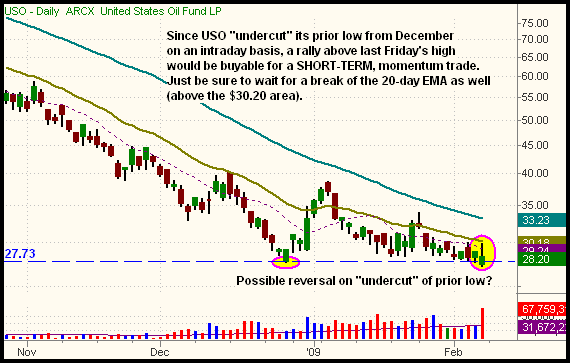
Since USO is trading at its dead low, it's imperative that an entry into USO is not attempted unless it rallies above last Friday's high and its 20-day exponential moving average (over the $30.20 area). Buying below the $30 level is akin to the proverbial "catching a falling knife." Our intended entry point, on the other hand, is much safer because it forces USO to confirm its short-term momentum has reversed. Thereafter, the "short squeeze" should do the rest. If USO does trigger, note that this should be played as a "hit and run" play that you're in and out of before the first pullback occurs, an approximate holding period of 2 to 5 days. ETFs near their lows, when we occasionally trade them, are always taken with a much shorter-term horizon than ETFs consolidating within their uptrends. The former type of trade adds to the bottom line of our annual profits, but the bulk of our profits come from the latter type of trade (like GDX shown below).
Market Vectors Gold Miners (GDX), comprised of a basket of individual gold mining stocks, is now poised to breakout and make another leg up within its current uptrend. Its annotated daily chart is shown below:
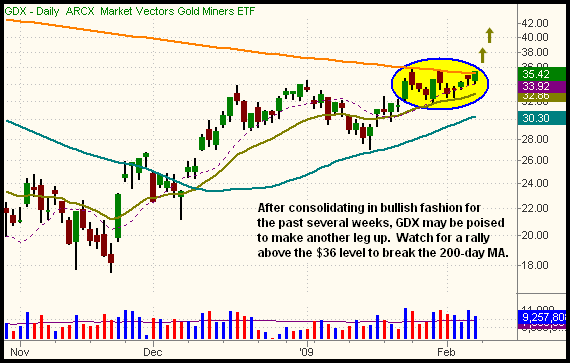
Over the past several weeks, GDX has been consolidating in a tight range, holding above support of its 20-day exponential moving average (the beige line), and even support of its very short-term 10-day moving average (the dotted purple line). Typically, only the strongest-trending ETFs will ride along support of their 10-day moving averages. Most apparent on the chart above is how GDX backed off after testing major resistance of its 200-day moving average (the orange line) on January 26 and 30. Last Friday, GDX closed just a tad above that pivotal moving average. Since each test of a resistance level weakens the resistance, this third time could be a charm, especially considering the healthy consolidation of the past few weeks.
If GDX manages to break out above its January 26 high of $36.00, it will also correlate to a breakout above the 200-day moving average on this third attempt. If that occurs, GDX is buyable for a short-term, momentum-based rally. Though we already bought GDX back on December 26, with an entry price of $31.40, traders who missed our initial entry might consider a secondary buy point above $36. Just be sure to use an accordingly tighter stop, just below the breakout level, if going with this secondary, higher entry point.
Presently, our GDX position is showing an unrealized gain of more than 12% (4 points), but its price action has not yet given us any reason to sell. Therefore, we'll simply trail our stop higher if/when it makes another leg up. Considering approximately 80% of our annual profits are the result of just our top 20% of trades (Pareto's principle), it's imperative to let winners ride as long as the steady trend remains. This is also the reason we've not yet taken profits on Gold Double Long (DGP), which is showing a 20% unrealized gain since our entry point (and is consolidating in a tight range as well). Even if you make a lot of mistakes in your trading business, you'll still be net profitable at the end of the year if you simply do two things right; cut your losing trades as soon as they hit their stops and let your winners ride until there is a technical reason to sell. The challenging part, of course, is applying this in actuality, not only understanding it theoretically.
Open ETF positions:
Long - DGP, GDX, IBB, UGA
Short - (none)
Deron Wagner is the Founder and Head Trader of both Morpheus Capital LP, a U.S. hedge fund, and Morpheus Trading Group, a trader education firm launched in 2001 that provides daily technical analysis of the leading ETFs and stocks. For a free trial to the full version of The Wagner Daily or to learn about Wagner's other services, visit MorpheusTrading.com or send an e-mail to deron@morpheustrading.com.
|



 Free Festival of Traders Videos


