| The Wagner Daily ETF Report For February 5 |
| By Deron Wagner |
Published
02/5/2009
|
Stocks
|
Unrated
|
|
|
|
The Wagner Daily ETF Report For February 5
Building on the Nasdaq's recent bullish momentum, stocks got off to a strong start yesterday morning, but the troublesome 50-day moving average gave traders an excuse to sell in the afternoon. Up more than 2% at its morning high, the Nasdaq broke its short-lived winning streak by settling 0.1% lower. The S&P 500 and Dow Jones Industrial Average surrendered smaller intraday gains, falling 0.8% and 1.5% respectively. The small-cap Russell 2000 slid 1.0%, as the S&P Midcap 400 dipped 0.2%. Opposite of the previous day, the main stock market indexes closed near their intraday lows.
Turnover ran higher throughout the day, causing a potential "accumulation day" to morph into a session of higher volume losses. Total volume in the NYSE increased 3%, while volume in the Nasdaq rose 7% above the previous day's level. Wednesday's "distribution day" marked the second occurrence of institutional selling within the past four sessions. A healthy market can typically absorb three to four days of higher volume losses, but more than four "distribution days" within a three to four-week period is often an intermediate-term death-knell to the stock market. Further, since the current market certainly does not qualify as "healthy," the overhead supply created from just this week's two days of higher volume selling has the potential to spark a substantial sell-off in the near-term.
If yesterday's weakness picks up momentum, the number of decent short selling opportunities should start to increase. One such ETF that may be in play in the coming days is UltraShort Oil and Gas ProShares (DUG). The setup is shown on the daily chart below:
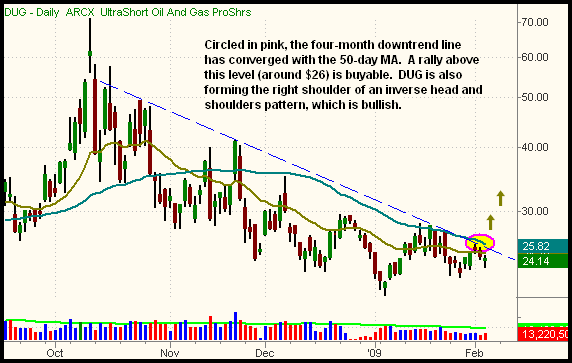
On the chart above, notice how the four-month downtrend line of DUG is now converging with resistance of the 50-day moving average (the teal line). We like DUG for buy entry on a rally above that convergence (the $26 area), which also puts DUG above its February 2 high. Additionally, DUG is now forming the right shoulder of an "inverse head and shoulders" pattern. The left shoulder formed in December, the head at the beginning of January, and right shoulder has been forming for the past several weeks. A rally above the December high ($28 area) would break the "neckline."
Like the rest of the "Short" and "UltraShort" ETFs from ProShares, DUG is designed to move in the opposite direction of its underlying sector (oil and gas). DUG also moves with greater volatility than many ETFs because it uses derivatives to provide leverage. Since DUG is inversely correlated to the direction of oil and gas, one can enter a bearish position simply through buying DUG, rather than initiating a traditional short sale. The greatest benefit of buying the inversely correlated ETFs, rather than selling short "normal" ETFs, is that bearish positions can now be entered in retirement accounts such as IRAs. Short selling, on the other hand, is not permissible because IRAs are non-marginable, cash accounts. Another benefit of trading the inversely correlated ETFs is a psychological one, as some traders have a mental block against the mechanics of short selling.
Several days ago, we discussed the tug-of-war that was taking place between the relative strength of the Nasdaq, and the weakness of the Dow. Until yesterday, it was starting to look as though the Nasdaq may win the battle, dragging the Dow higher in the process, but now the Dow has fallen back down to test its January lows. Although the Nasdaq zoomed well above its 50-day moving average yesterday morning, its nearly flat close means that pivotal test of resistance is still in play. Corporate earnings season, still in full-swing, is likely to throw more unexpected curveballs as well. Be alert and prepared for continued indecision in the short-term.
Open ETF positions:
Long - DGP, GDX, IBB, UGA
Short - (none)
Deron Wagner is the Founder and Head Trader of both Morpheus Capital LP, a U.S. hedge fund, and Morpheus Trading Group, a trader education firm launched in 2001 that provides daily technical analysis of the leading ETFs and stocks. For a free trial to the full version of The Wagner Daily or to learn about Wagner's other services, visit MorpheusTrading.com or send an e-mail to deron@morpheustrading.com.
|



 Free Festival of Traders Videos


