| The Wagner Daily ETF Report For January 14 |
| By Deron Wagner |
Published
01/14/2009
|
Stocks
|
Unrated
|
|
|
|
The Wagner Daily ETF Report For January 14
A tug-of-war between the bulls and bears led to an erratic, indecisive session of trading yesterday. By the closing bell, the bulls slightly claimed the upper hand, as most of the major indices finished modestly higher, and just above the middle of their intraday ranges. The Nasdaq Composite gained 0.5% and the S&P 500 advanced 0.2%, but the blue-chip Dow Jones Industrial Average closed 0.3% lower. Small and mid-cap stocks showed relative strength; both the Russell 2000 and S&P Midcap 400 indices climbed 1.1%.
Total volume in the NYSE was on par with the previous day's level, but turnover in the Nasdaq increased 10% The higher volume gain in the Nasdaq enabled the index to score a bullish "accumulation day." However, based on the choppy intraday price action, relatively small gains of the S&P and Nasdaq, and the loss in the Dow, it's safe to say yesterday was not a clear cut day of institutional buying. In both exchanges, advancing volume only marginally exceeded declining volume.
For intermediate-term trends, we typically focus on chart patterns of the daily and weekly time intervals. Since the S&P 500, Nasdaq Composite, and Dow Jones Industrial Average held support of their late December lows, but failed to move back above their 50-day moving averages, yesterday's action did little to change the intermediate-term picture of the broad market. However, drilling down to a smaller time frame, we see the main stock market indexes may be poised to break out above resistance of their short-term downtrend lines, visible most easily on the 60-minute (hourly) intraday charts. Below, we've annotated the one-week downtrend line on the hourly chart of Ultra S&P 500 ProShares (SDS), a popular ETF proxy for the S&P 500 Index (moving averages removed so you can more easily see the trendline):
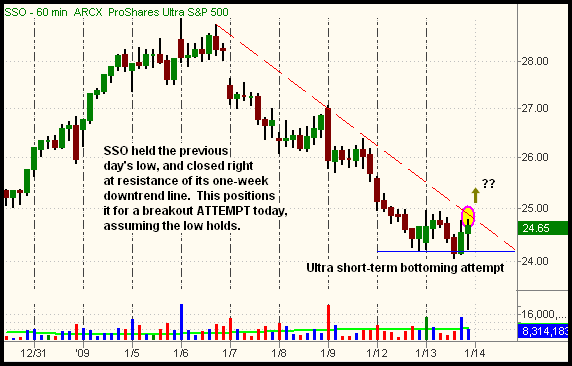
Although SSO closed right at resistance of its downtrend line, this time it held support of the previous day's low. Unless that ultra short-term "double bottom" is broken in today's session, we should expect the SSO (and the S&P 500 Index) to break out above the short-term downtrend line shown above. If it does, we'll be closely monitoring how much momentum is behind the breakout, which would represent an attempted resumption of the intermediate-term uptrend from the November 2008 lows. A similar short-term pattern is found on the hourly chart of Ultra QQQ ProShares (QLD), a well-known ETF proxy for the tech-heavy Nasdaq 100 Index:
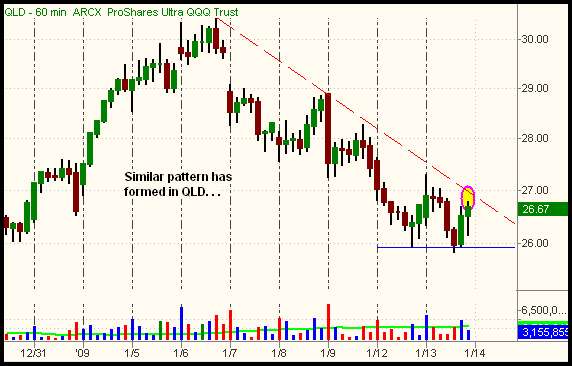
Because of the short-term basing patterns shown above, we bought Ultra S&P MidCap ProShares (MVV) late yesterday afternoon. Though MVV has not yet broken out above resistance of its short-term downtrend line, we bought it because the S&P Midcap 400 is the only one of the major indices that has not broken below its 50-day moving average this week. This is in line with yesterday's comment of, "new long positions only make sense if the major indices manage to reclaim their 50-day MAs." On the daily chart of the S&P Midcap 400 below, notice how the index is trying to reverse right at support of its 50-day MA, thereby creating an ideal buy entry with a positive risk/reward ratio:
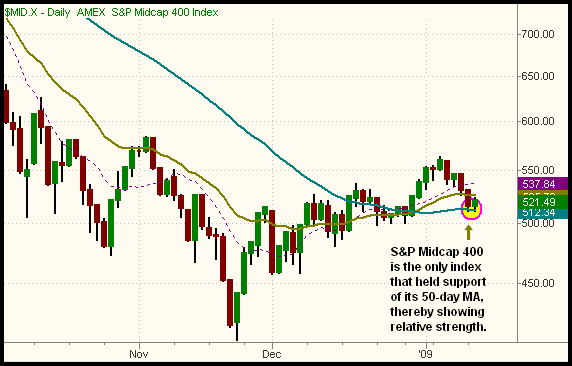
If the S&P 500 and Nasdaq hold above their short-term downtrend lines and start to pick up bullish momentum, MVV should show relative strength to the rest of the broad market because it has less technical resistance to contend with. Still, to protect against the possibility of a failed bullish reversal, we're running a tight protective stop just below the late December "swing low" of $21.60.
Earnings season has begun kicking into high gear, as both Intel and JP Morgan Chase are slated to report their latest quarterly results tomorrow. Next week, a slew of other market-moving companies will report as well. We all know earnings reports are generally not expected to be impressive, but this is could be a good thing for the market if investors' mental expectations are already low enough. With earnings reports, it's always the stock market's subsequent reaction that matters, not the actual results.
Open ETF positions:
Long - SLV, GDX, TAN, MVV
Short - (none)
Deron Wagner is the Founder and Head Trader of both Morpheus Capital LP, a U.S. hedge fund, and Morpheus Trading Group, a trader education firm launched in 2001 that provides daily technical analysis of the leading ETFs and stocks. For a free trial to the full version of The Wagner Daily or to learn about Wagner's other services, visit MorpheusTrading.com or send an e-mail to deron@morpheustrading.com.
|



 Free Festival of Traders Videos


