| The Wagner Daily ETF Report For August 8 |
| By Deron Wagner |
Published
08/8/2008
|
Stocks
|
Unrated
|
|
|
|
The Wagner Daily ETF Report For August 8
Resistance of last month's "swing highs" in most of the major indices triggered a broad-based round of selling yesterday. After opening lower, stocks attempted to recover throughout the morning session, but the bears resumed control in the afternoon, causing the main stock market indexes to fall below their opening lows. The Nasdaq Composite declined 1.0%, the S&P 500 1.8%, and the Dow Jones Industrial Average 1.9%. The small-cap Russell 2000 and S&P Midcap 400 lost 1.7% and 1.5% respectively. All the major indices finished near their intraday lows.
Turnover was mixed. Total volume in the NYSE rose 7% above the previous day's level, but volume in the Nasdaq eased 1%. The higher volume selling in the NYSE caused the S&P 500 to register a bearish "distribution day," the second in a week. The Nasdaq narrowly avoided having the same label. Market internals were worse in the NYSE, where declining volume exceeded advancing volume by a margin of 4 to 1. The Nasdaq adv/dec volume ratio was negative by just 2 to 1.
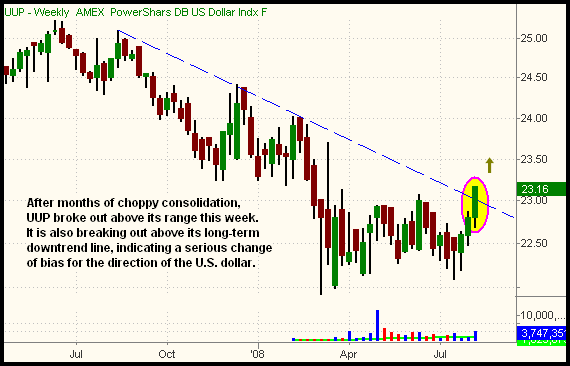
As commodities continue to get hammered, the U.S. dollar continues to strengthen. Yesterday, the euro fell below a five-month base of support, versus the U.S. dollar. This enabled our long position in the PowerShares U.S. Dollar Index (UUP) to break out and close above its 200-day moving average for the first time in about a year. UUP also broke out above its primary downtrend line, indicating a serious change of long-term bias for the dollar. The UUP breakout above its long-term downtrend line is shown on the weekly chart below:
Yesterday's sell-off came right as the S&P 500 and Dow Jones Industrial Average tested key resistance of their "swing highs" from July 23. When the major indices approach such obvious and pivotal areas of resistance, it's not uncommon for stocks to "shake out the weak hands" by giving the appearance that the rally attempt is dead. However, the daily charts of the S&P and Dow show that yesterday's sell-off was not damaging on a technical level. In fact, both indexes merely pulled back to support of their intermediate-term uptrend lines. This is shown on the daily charts of the S&P and Dow below:
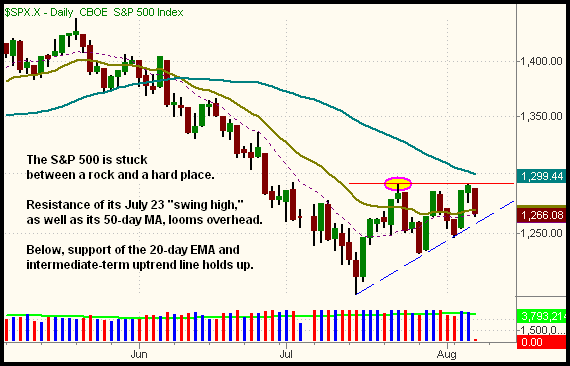
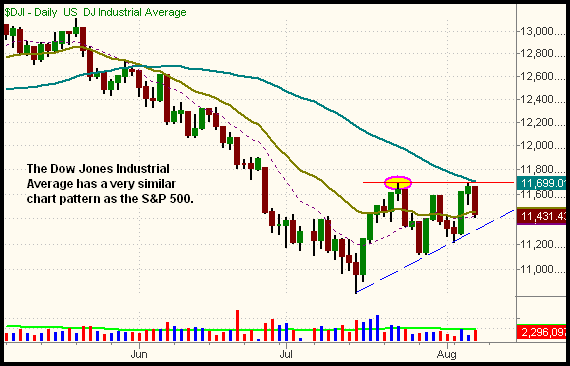
On each chart above, the red horizontal lines mark resistance of the indices' "swing highs" from last month. Notice how the 50-day moving averages (the teal lines) have descended to roughly converge with those horizontal areas of price resistance as well. The blue, upward-sloping dashed lines mark support of the intermediate-term uptrends off the July lows. Despite yesterday's steep losses, notice how both indexes are still above support of their intermediate-term uptrend lines. Further, both the S&P and Dow closed at support of their 10-day moving averages (the purple dotted lines), and just a hair below their 20-day exponential moving averages (the beige lines).
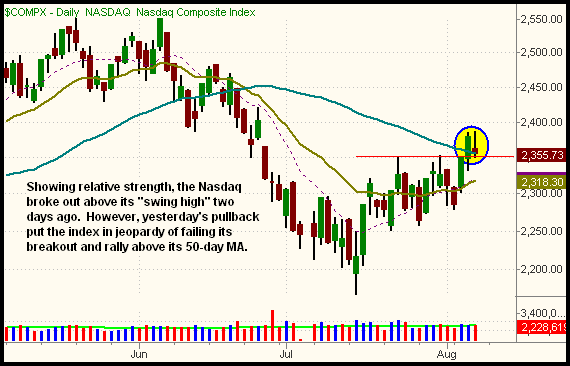
The Nasdaq Composite is looking a little better than the S&P and Dow, as the index has already rallied to a new "swing high." However, yesterday's loss caused the index to fall back to its 50-day MA and breakout level. Another day of selling in the Nasdaq will cause the recent breakout to fail. Although it will be technically negative if the Nasdaq closes below yesterday's low, the bigger issue is whether or not stocks log further "distribution days" by falling on higher volume. Below is the daily chart of the Nasdaq Composite:
One could reasonably say the S&P 500 and Dow Jones Industrial Average are stuck between a rock and a hard place. The intermediate-term uptrend lines, as well as 10 and 20-day MAs, are providing support below. But just overhead, there is horizontal price resistance that roughly converges with the 50-day MAs of the S&P and Dow. Until there is firm resolution of either a break below support, or breakout above resistance, we expect to see choppy, range-bound trading in the near-term. As such, it may be a good idea to hold off on new positions until stocks make up their mind by making a clear move above resistance or below support. Be careful to avoid overtrading in this environment, and remember to always trade what you see, not what you think!
Open ETF positions:
Long - UWM, UUP, TAN, IYH
Short - (none)
Deron Wagner is the Founder and Head Trader of both Morpheus Capital LP, a U.S. hedge fund, and Morpheus Trading Group, a trader education firm launched in 2001 that provides daily technical analysis of the leading ETFs and stocks. For a free trial to the full version of The Wagner Daily or to learn about Wagner's other services, visit MorpheusTrading.com or send an e-mail to deron@morpheustrading.com.
|



 Free Festival of Traders Videos


