| The Wagner Daily ETF Report for January 31 |
| By Deron Wagner |
Published
01/31/2008
|
Stocks
|
Unrated
|
|
|
|
The Wagner Daily ETF Report for January 31
A half-point rate cut by the Fed yesterday afternoon initially got the bulls quite excited, but the knee-jerk reaction faded just as quickly. Both the S&P 500 and Nasdaq Composite had surged to a 1.6% gain one hour after the 2:15 pm announcement on economic policy. When the closing bell rang forty-five minutes later, the S&P and Nasdaq finished lower by 0.5% and 0.4% respectively. The Dow Jones Industrial Average fell more than 200 points from its intraday peak, settling 0.3% lower. Small and mid-cap stocks fared worse. The Russell 2000 slid 1.4%, as the S&P Midcap 400 lost 1.1%. All the main stock market indexes closed near their intraday lows.
Turnover in the NYSE rose 15% above the previous day's level, while trading in the Nasdaq ticked 19% higher. Higher volume on Fed days is typical because traders and investors often jump back in the market immediately following key afternoon announcements. It was negative, however, that the higher volume levels were accompanied by losses across the board. In both the NYSE and Nasdaq, declining volume exceeded declining volume by approximately 2 to 1. While that's not an overly bad margin, realize the adv/dec volume ratio was actually positive by more than 3 to 1 less than an hour earlier.
If you've been paying attention to our analysis of the broad market over the past several days, yesterday afternoon's action should not have been surprising. We've been expecting a swift move above last week's highs, followed by immediate selling into strength and failure of the breakout attempt. That's exactly what happened in the S&P and Dow yesterday afternoon. The Nasdaq was a bit too weak to make it above last week's high. The intraday probe above last week's high is shown on the daily chart of the S&P 500 below. Notice also how the 20-day exponential moving average provided additional resistance:
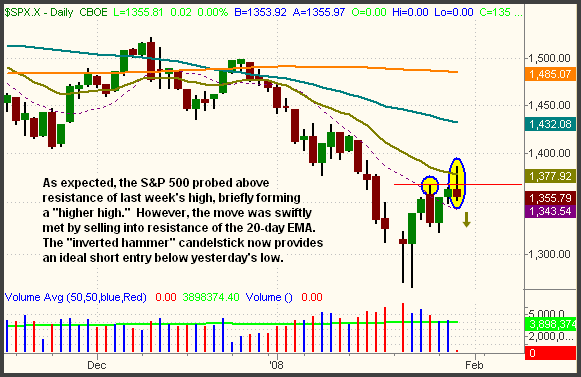
As you might recall, this is precisely the price action we were waiting for before initiating new short positions in anticipation of a resumption of the primary downtrends. The "inverted hammer" candlestick patterns formed by the major indices yesterday presents us with ideal short entry points below yesterday's lows. Protective stops can be relatively tightly placed above yesterday's intraday highs. While the S&P 500 formed a bearish "inverted hammer" at the top of its recent bounce off the lows, the inversely correlated UltraShort S&P 500 ProShares (SDS) conversely formed a bullish "hammer" candlestick at the bottom of its recent pullback off the high. Take a look:
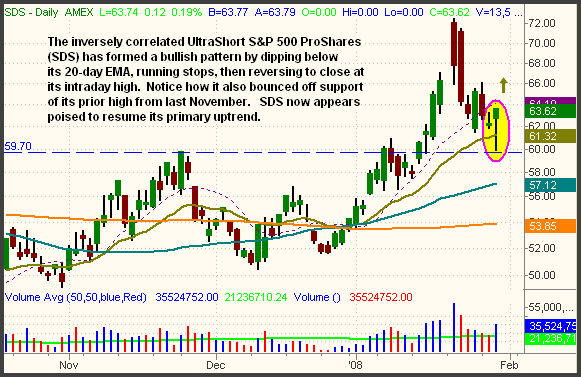
If the chart pattern of SDS was that of any individual stock, the intraday shakeout below support of the 20-day EMA, but closing price above it, would be quite bullish. It's also bullish that SDS bounced off new support of its prior high (annotated by the dashed horizontal line). As you can see below, the UltraShort Dow 30 ProShares (DXD) formed a similar pattern as well:
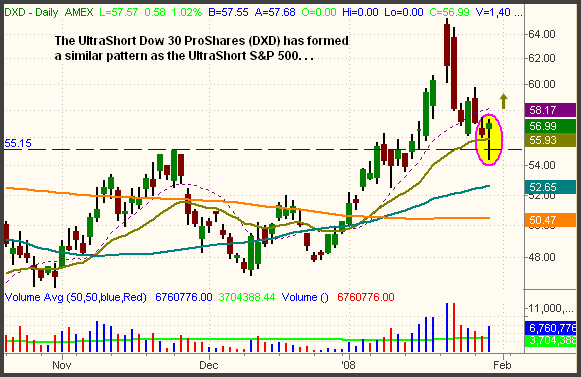
If both SDS and DXD are poised to resume their primary uptrends from here, that obviously means the overall stock market may be positioned to resume its primary downtrend. As such, regular subscribers of The Wagner Daily should note our specific trigger, stop, and target prices for potential long entry into SDS, detailed below. Still, we certainly do not expect new short entries to be like shooting fish in a barrel. Stocks remain at their most volatile and whippy levels in years, so a tug-of-war between the bulls and bears could easily ensue. The Fed is also working hard to show it will do whatever it takes to save the market, though the reaction to the last two cuts over the past two weeks has been unimpressive.
We have no firm opinion on how long the bearishness will continue. Rather, we are operating in the same manner we always do -- by simply reacting to what the charts are telling us. Clearly, the major indices remain in firmly established intermediate and long-term downtrends. Soon, these primary downtrends should pressure the less significant shorter-term bounces that began last week. The Short and UltraShort ProShares ETFs, of which there are now 58 different ones, provide a great way to capture future downside in the market, without the need to sell short.
Open ETF positions:
Long - XHB
Short - (none)
Deron Wagner is the Founder and Head Trader of both Morpheus Capital LP, a U.S. hedge fund, and Morpheus Trading Group, a trader education firm launched in 2001 that provides daily technical analysis of the leading ETFs and stocks. For a free trial to the full version of The Wagner Daily or to learn about Wagner's other services, visit MorpheusTrading.com or send an e-mail to deron@morpheustrading.com.
|



 Free Festival of Traders Videos


