| The Wagner Daily ETF Report for January 24 |
| By Deron Wagner |
Published
01/24/2008
|
Stocks
|
Unrated
|
|
|
|
The Wagner Daily ETF Report for January 24
A wild trading session kept both the bulls and bears on their toes yesterday, but stocks finally closed with a solid round of gains. The major indices gapped several percent lower on the open, attempted to recover in the first hour, then dipped to new intraday lows by mid-day. Buyers subsequently arrived in full force several hours later, reversing staggering losses in many sectors. Whipping around in a breathtaking 600-point intraday range, the Dow Jones Industrial Average eventually settled 2.5% (299 points) higher. The S&P 500 similarly gained 2.1%, but relative weakness in large cap techs held the Nasdaq Composite to a 1.1% gain. Small-cap stocks continued to show relative strength, sending the Russell 2000 Index 3.3% higher. Our long position in the ProShares Ultra Russell 2000 (UWM), which we bought near the previous day's low, zoomed 6.7%. It also closed just shy of our six-point price target. The S&P Midcap 400 rose 2.3%. For the first time in a week, all the major indices finished at their intraday highs.
Total volume in the NYSE increased 11%, while volume in the Nasdaq rose 17% above the previous day's level. The substantial gains on strong volume enabled both the S&P and Nasdaq to score a rare "accumulation day," indicative of institutional buying. Turnover again swelled to fresh multi-month highs. Trading picked up for the fourth straight day. Advancing volume in the NYSE exceeded declining volume by nearly 3 to 1. The Nasdaq adv/dec volume ratio finished only marginally positive, but was firmly negative by 4 to 1 earlier in the day.
When the stock market is in a strong downtrend, there are two main things we look for to determine where a short to intermediate-term bottom might form. The first is "capitulation." This occurs when stocks that are already beaten down plummet even further on sharply higher volume, then the market subsequently reverses just as strongly. Capitulation is the point at which those who held on the whole way down and didn't quickly cut their losses finally throw in the towel and sell at any price. This enables institutions to scoop up shares at "bargain" prices, instantly reversing the momentum. One could say with a fair degree of confidence that yesterday was a day of capitulation.
Another technical formation that helps us predict near-term bottoms in downtrending markets is a successful test of prior lows that were set within the past several days (a "double bottom"). Just after mid-day yesterday, we noticed that several of the major indices dipped below and "undercut" the prior day's lows, but held firm and refused to go lower. The "undercut" of the prior day's lows is significant because it washes out the "weak hands" who had their stops set just below yesterday's low. This absorbs overhead supply and makes it easier for stocks to subsequently rally.
Upon noticing the potential double bottom off the prior day's lows in the broad market, we sent a real-time e-mail alert to subscribers of The Wagner Daily, informing them of our decision to buy the ProShares Ultra S&P 500 (SSO) if the S&P 500 Index moved above its intraday downtrend after successfully forming a short-term the double bottom. That occurred shortly thereafter, triggering our long entry into SSO at a very nice price. The S&P 500 ripped 4% after our entry into SSO, sending SSO more than 8% higher. The 15-minute intraday chart of SSO below illustrates the near-term "double bottom" formation, as well as our entry point yesterday afternoon:
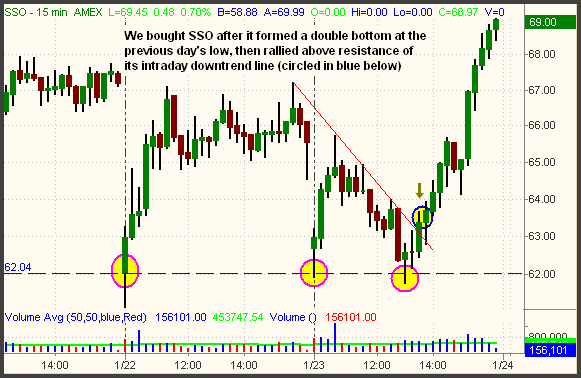
Presently, SSO is showing a gain of 5.6 points since yesterday's entry. However, we believe it should continue higher over the next several days. As with the UWM entry, our profit target in SSO is just below resistance its 10-day moving average ($72.22). Going into today, we can now trail a stop higher to protect our profit while maximizing the gain. Specifically, the 20-MA on the hourly chart should now act as firm support on a pullback.
If you sold long positions near yesterday morning's lows, the afternoon rally might have been rather frustrating. If this happened, I would like to humbly remind you of the power of re-entering positions when they eventually go the right way. As a novice trader, I used to have an illogical mental block against re-entering stocks at a higher price than I sold just an hour or day before. I thought that perhaps I was getting in at too high of a price and shouldn't be "chasing" the stock, but the stock would then go on to rally many points higher. Although it's certainly true that paying up a dollar or two on the entry price results in lower profit than staying with the original entry, the benefits are worth it. Consider this -- Would you rather net "only" a 6-point gain out of a 10-point move, or net 0 points out of it? As long as the reward/risk ratio is not significantly skewed by your re-entry price, then by all means be sure to re-enter, even if at a higher price. Further, ETFs and stocks that just scared everyone out are all the more likely to zoom higher when they resume their bullish upward momentum. This is due to some of the overhead supply immediately being absorbed.
The combination of yesterday's "capitulation" and "double bottom" formation means that stocks are likely to continue higher in the short to intermediate-term. However, it is unlikely that the lows of the past two days will be the ultimate lows of the new bear market. Traders who properly respect risk should begin seeing tradeable buying opportunities in ETFs with relative strength and reversal patterns on their daily charts. Still, wise traders and investors must remember the overall market remains firmly in a downtrend. We'll capitalize on the long side of the market as long as we are able, but ideal short selling entry points will begin to present themselves when the buyers eventually dry up again. Staying nimble, reducing your share size, and taking profits quicker than usual are still the keys to profiting in the current market.
Open ETF positions:
Long - UWM, SSO
Short - (none)
Deron Wagner is the Founder and Head Trader of both Morpheus Capital LP, a U.S. hedge fund, and Morpheus Trading Group, a trader education firm launched in 2001 that provides daily technical analysis of the leading ETFs and stocks. For a free trial to the full version of The Wagner Daily or to learn about Wagner's other services, visit MorpheusTrading.com or send an e-mail to deron@morpheustrading.com.
|



 Free Festival of Traders Videos


