| The Wagner Daily ETF Report for January 10 |
| By Deron Wagner |
Published
01/10/2008
|
Stocks
|
Unrated
|
|
|
|
The Wagner Daily ETF Report for January 10
Throughout most of the session, it looked as though stocks would continue to build on recent losses, but a swift rally into the 2:30 pm reversal period provided welcome relief. The Nasdaq Composite snapped its eight-day losing streak by reversing a 1.3% intraday loss into a 1.4% gain. The S&P 500 also advanced 1.4%, as the Dow Jones Industrial Average rallied 1.2%. Relative weakness in small and mid-cap stocks remained. The Russell 2000 and S&P Midcap 400 indices were higher by 1.0% and 0.5% respectively. For the first time since December 26, all of the major indices closed at their best levels of the day.
One of the most positive things about the reversal day was that turnover rose as well. Total volume in both the NYSE and Nasdaq came in 9% above the previous day's levels. Combined with the main stock market indexes finishing at their intraday highs, the increased trading activity tells us institutions were at least nibbling on the buy side. Across the board, advancing volume exceeded declining volume by a modest ratio of just 3:2. However, declining volume was outpacing advancing volume by 3 to 1 when stocks were at their lows. Market internals therefore rapidly improved in the final ninety minutes of trading.
In yesterday's commentary, we discussed the prior lows of August 2007 as being major areas of support in the S&P, Nasdaq, and Dow. We also went on to say that, "A retest of the August 2007 lows in each of the major indices is now virtually assured." Though we didn't necessarily expect it to happen the same day, a test of the August lows is exactly what happened during the mid-day weakness. A test of such a major support level on the weekly charts was undoubtedly the main impetus for the late-day rally. If traders and investors were looking for a relatively "low-risk" place to begin bargain hunting operations, support of the August lows provided the perfect excuse for doing so. Below is an updated look at the weekly charts of the Dow, S&P, and Nasdaq:
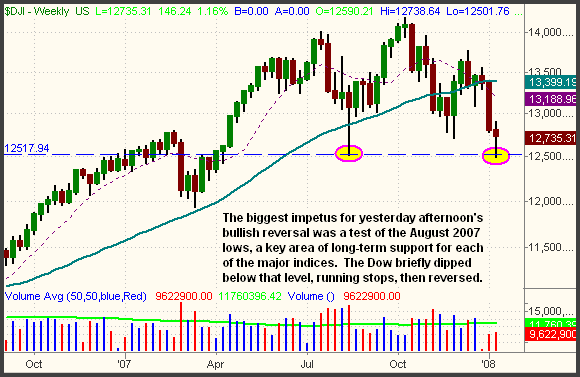
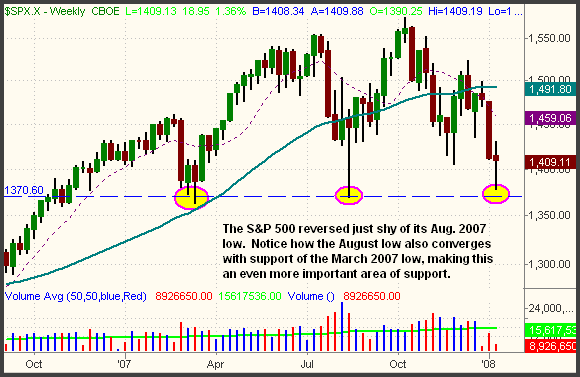
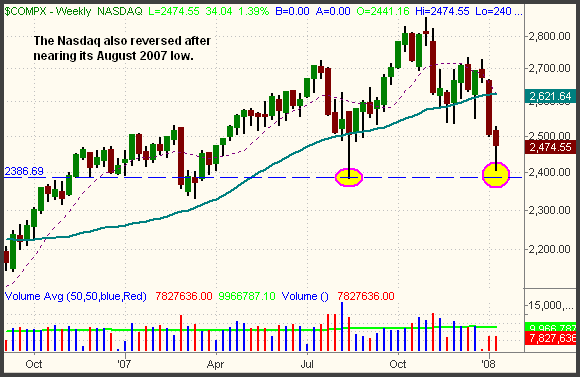
Of the "big 3" main stock market indexes, only the Dow actually violated its August intraday low yesterday, probing 17 points below that level before reversing. Still, the S&P came within just 8 points (0.6%), and the Nasdaq came within 21 points (0.8%). On the weekly chart of the S&P, notice how the August low also converges with support from the lows of March, 2007. This makes support of the August, 2007 low even more significant now, as a clean break below that level would instantly lead to a new 52-week low, as the Russell 2000 has recently done. The August, 2007 lows in the Dow and Nasdaq are a bit higher than their March 2007 lows, so they have a little more "wiggle room" before being in danger of fresh 52-week lows.
The question on everyone's minds right now is the actual significance of yesterday's rally. While we obviously have no way of knowing how far the bounce will carry us, yesterday's intraday price action was bullish overall. Specifically, it was positive that the mid-day losses undercut the previous day's lows before stocks rallied to new intraday highs. Had the major indices held above the prior day's lows the entire time, yesterday would have been an "inside day" instead. Such action would subsequently have had a greater chance of its lows being tested again today.
Yesterday, we said that a tradeable bounce for short-term traders would eventually come. Based on key support of the August 2007 lows and yesterday's bullish intraday price action, it appears that time is now. Because of the relative strength it showed in the final hour, we bought the beaten-down Financial SPDR (XLF) for a short-term momentum play. Although we would never buy a strongly downtrending ETF with high expectations of an intermediate-term hold, we are merely looking to capture a quick gain on a bounce from "oversold" conditions over the next several days. If it begins to falter or show weakness before then, we'll quickly bail out and close the trade for a scratch or small gain. Regardless of which stocks or ETFs you might buy right now, we suggest keeping this proactive, short-term mentality as well. There is way too much overhead supply and technical damage on the charts to expect anything more than a near-term countertrend retracement. As this bounce plays out, we'll simultaneously be searching for low-risk short sale entries so that we are prepared if the well-established primary downtrends continue longer.
Open ETF positions:
Long - XLF
Short - (none)
Deron Wagner is the Founder and Head Trader of both Morpheus Capital LP, a U.S. hedge fund, and Morpheus Trading Group, a trader education firm launched in 2001 that provides daily technical analysis of the leading ETFs and stocks. For a free trial to the full version of The Wagner Daily or to learn about Wagner's other services, visit MorpheusTrading.com or send an e-mail to deron@morpheustrading.com.
|



 Free Festival of Traders Videos


