| The Wagner Daily ETF Report for November 5 |
| By Deron Wagner |
Published
11/4/2007
|
Stocks
|
Unrated
|
|
|
|
The Wagner Daily ETF Report for November 5
Downward momentum from the November 1 sell-off carried over into last Friday morning's session, but the major indices later stabilized to close near the top of their intraday ranges. The benchmark S&P 500 Index edged 0.1% higher, shaking off its morning loss of 1.1%, while the Dow Jones Industrial Average similarly reversed its 0.9% loss to a 0.3% closing gain. Not surprisingly, the Nasdaq Composite continued to show relative strength by advancing a respectable 0.6%. Conversely, the S&P Midcap 400 Index lagged the market by slipping 0.2%. The small-cap Russell 2000 was higher by 0.3%.
Turnover receded across the board. Total volume in the NYSE was 2% below the previous day's level, while volume in the Nasdaq came in 7% lower. Nevertheless, volume levels remained firmly above average, which has generally been the case since the S&P 500 first broke below support of its 50-day MA on October 19. Despite last Friday's broad-based gains, market internals were mixed. Advancing volume in the Nasdaq exceeded declining volume by a margin of just over 2 to 1, but the NYSE ratio was fractionally negative.
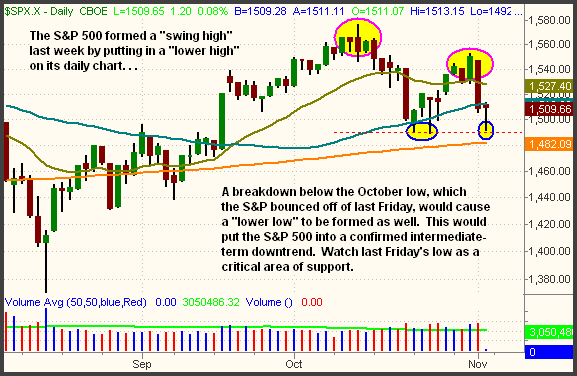
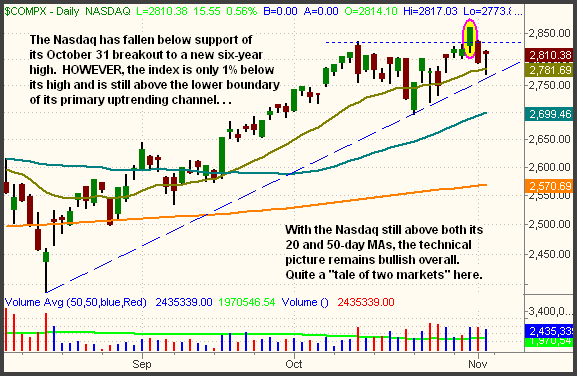
The bullish price divergence the Nasdaq exhibited throughout the month of October continues to be quite apparent going into November. Both the S&P 500 and Dow Industrials have formed "lower highs" and are trading below their 50-day moving averages, about to reverse into intermediate-term downtrends. The Nasdaq Composite, however, is consolidating just 1% below its six-year high, well above both its 20 and 50-day MAs. This divergence is shown on the daily charts of the S&P and Nasdaq below. Note our annotations on the chart of the S&P 500, which shows how the index is in danger of entering into a confirmed intermediate-term downtrend. The same is true of the Dow (not shown). As you can see, last Friday's low is a key area of support going into this week:
When the main stock market indexes begin to trade in opposite directions, as they are now, the tug-of-war between the bulls and bears usually leads to choppy, erratic day-to-day price action in the broad market. Proper selection of individual stocks and ETFs also becomes of paramount importance in such conditions.
In the current environment, one might consider avoiding the broad-based ETFs altogether and focusing instead on specific industry sector and specialized ETFs with relative strength or weakness to the major indices. If a sector is so strong that it merely moves sideways while the broad market falls, what do you think happens when the broad market eventually bounces? Relative strength enables that sector to quickly shoot to new highs. Conversely, weak sectors that fail to move higher when the major indices rally will be the first to drop to new lows when the overall market pulls back. The dynamic development of relative strength and weakness occurs due to changes in institutional sector rotation.
Unlike individual investors, who have the luxury to be fully positioned in cash during periods of uncertainty, institutions such as mutual funds have bylaws that state they can only be positioned in a small percentage of cash, typically 1% or less. If the industry sector they were heavily accumulating suddenly starts showing weakness, institutions will obviously rotate their massive buying power out of that underperforming sector and into another that has more promising upside potential. Our job as sector traders is simply to ride along on the coattails of this institutional money flow through buying the sector ETFs with the most relative strength and/or selling short those with the most relative weakness.
Currently, we are holding one broad-based ETF (a short position in the Russell 2000), but most of our trades in recent weeks have been within specific industry sectors and specialized ETFs, such as commodities or fixed-income. Specialty ETFs may have an ideal spot in your portfolio right now because they are not directly correlated to the direction of the overall stock market. That's why we bought back into the U.S. Natural Gas Fund (UNG) last Friday, when it pulled back to test support of its breakout level. We sold UNG into strength for a substantial profit the previous day, but liked the risk/reward of re-entering on the pullback. Not only is UNG reversing its downtrend, but we also like that it has essentially no correlation to the direction of the overall stock market. Rather, it simply tracks the price of the Natural Gas commodity contracts.
Over the next week, we'll be closely scanning for more opportunities of sectors that have strong price divergence from the broad market. We'll be reporting our findings, as well as searching for entry points in new trade setups on both sides of the market. For now, sectors such as Financials and Retail have been moving steadily lower, while tech sectors such as Software and Internets are climbing to new highs. Until the tug-of-war is won by either the bulls or bears, having a balanced portfolio not too heavily tilted in one direction is wise.
Open ETF positions:
Long - TWM, UNG
Short - (none, but TWM is a bearish position)
Deron Wagner is the Founder and Head Trader of both Morpheus Capital LP, a U.S. hedge fund, and Morpheus Trading Group, a trader education firm launched in 2001 that provides daily technical analysis of the leading ETFs and stocks. For a free trial to the full version of The Wagner Daily or to learn about Wagner's other services, visit MorpheusTrading.com or send an e-mail to deron@morpheustrading.com.
|



 Free Festival of Traders Videos


