| What Does the Future Hold for the Dollar? |
| By Todd Gordon |
Published
06/15/2007
|
Currency
|
Unrated
|
|
|
|
What Does the Future Hold for the Dollar?
I spent the whole day re-examining the longer-term picture of the markets, and more specifically the dollar going forward. After I get stopped out like I did in EUR/JPY I like to take a big step back and evaluate what I did right, what I did wrong, and what to do going forward. And to be straight forward, my analysis of EUR/JPY was textbook, and my execution of the trade was superb. I realized on Thursday that our entry was not ideal, so I booked a 5 point loss and re-offered into 90 with an 05 stop. In the end, I lost just 20 pips on a trade that was easily worth 80+. What happened? The trade simply didn't work, it happens all the time. That is exactly why you must think of trading as an artistic expression that only deals in probabilities, and not as a science with strict rules and boundaries that yields definitive results.
So, this morning I did quite a bit of analysis of the most important fundamental driver of the Foreign Exchange markets; interest rate differentials. I looked at the spread of the US 10 Yr bond yield over the German 10-year bond yield. That spread has been steadily decreasing in favor of the German yields as EUR/USD steadily approached the 1.3682 high. Keep in mind as the interest rate differentials between the Eurozone and US move in favor of the Eurozone, capital flows will favor the Euro sending the EUR/USD exchange rate higher. But just recently, the spread between the bond yields put in a rather dramatic bottom and popped up and through 12-month downtrend resistance in favor of US rates as our economic picture improved, despite the housing slump. Now, that spread is pulling back towards the trendline, but this time as support, which means technically speaking, the spread between US 10 yr / GB 10 Yr should continue to move higher, thus pressuring the EUR/USD exchange rate.
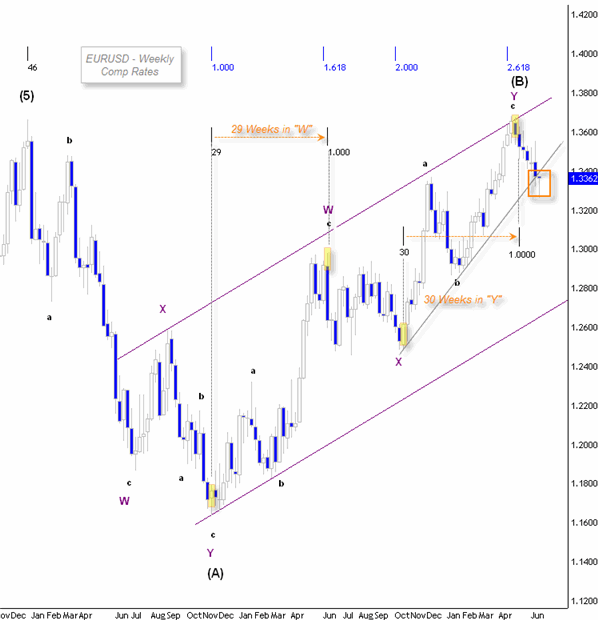
Further, the EUR/USD spot rate has just broken below trendline support shown within the orange rectangle. So, if EUR/USD remains below 1.3400 former trendline support, now resistance, we can call the large 1.1700 area 1.3600 area as a completed wave-B , which brings C-wave sellers in down to the parallel channel support below 1.3000.
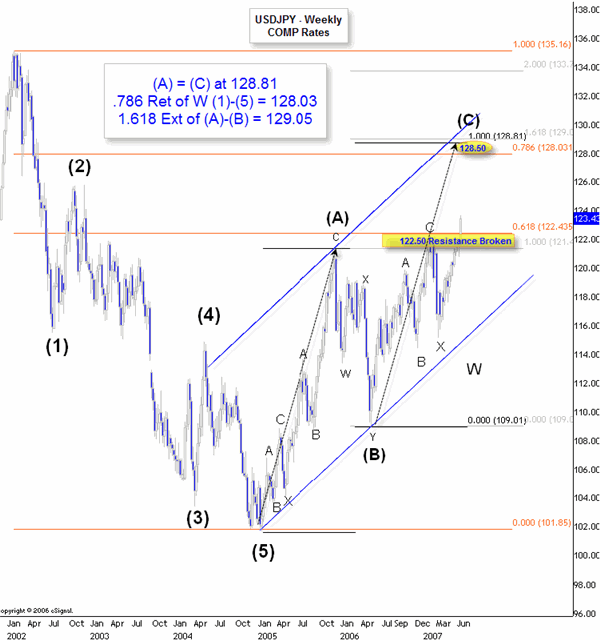
USD/JPY Weekly chart surprisingly and easily broke through massive 122.50 resistance this week. And with EUR/USD below the trendline resistance, a short EUR/JPY position most definitely seemed to be the way to go. USD/JPY has a ton of wave and Fib symmetry targets 5 big figures above us around 128.50.
So, for the 2nd half of this year, I am looking for a 4% move in USD/JPY towards 128.50, and an approximate 3.5% move in EUR/USD towards 1.2900. The USD/JPY and EUR/USD targets, if met at the same point in time, yield a EUR/JPY target of 165.75, or just 50 points away from the current rate. How did I arrive at the target? Just multiply 128.50 by 1.2900. So in conclusion, I will be shifting the focus away from the cross and towards the legs in anticipation of a shakeup in the US fixed income markets.
Todd Gordon is a Technical Currency Strategist and Fund Trader with GAIN Capital Group.
Disclaimer
The information and opinions in this report are for general information use only and are not intended as an offer or solicitation with respect to the purchase or sale of any currency. All opinions and information contained in this report are subject to change without notice. This report has been prepared without regard to the specific investment objectives, financial situation and needs of any particular recipient. While the information contained herein was obtained from sources believed to be reliable, author does not guarantee its accuracy or completeness, nor does author assume any liability for any direct, indirect or consequential loss that may result from the reliance by any person upon any such information or opinions.
|



 Free Festival of Traders Videos


