| The Odds Czar: Index Futures Biases for May 5 |
| By Art Collins |
Published
05/3/2008
|
Currency , Futures , Options , Stocks
|
Unrated
|
|
|
|
The Odds Czar: Index Futures Biases for May 5
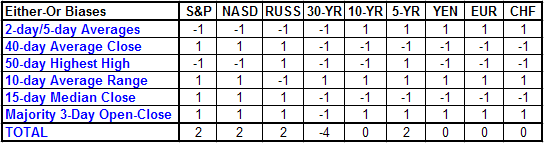
The indices are displaying solid buy signals for Monday, particularly the Russell. A lesser bullish flash is occurring across the currency complex.
Either-Or Biases
The first set of biases includes six biases that individually signal either long or short on a daily basis, except for the rare tie. Each bias has a +1 value for long bias, and a -1 for short. The bottom line is the sum total, which can range from -6 to 6. Positive totals are bullish; negative are bearish. For bullish signals (opposite is bearish):
1. The 2-day average is below the 5-day average.
2. The close is above the 40-day average.
3. The highest close of the last 50 days occurs before the lowest close of the last 50 days.
4. The day's trading range is smaller than the 10-day average range and the day's close is higher than the previous day's close OR the day's range is larger than the 10-day average range and the close is lower than the previous day's close.
5. The close is above the midpoint of the average 15-day range. (The 15-day high average plus the 15-day low average divided by 2.)
6. Fade the majority direction of the last three open-to-closes.
Infrequent Biases
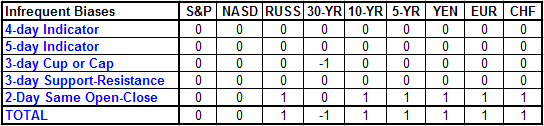
The five infrequent biases are listed below. For bullish signals (opposite is bearish):
1. Four successively higher closes were followed by yesterday's down close. Today's action was irrelevant.
2. Five successively lower closes were followed by today's up close.
3. CUP trade. For the last three trading days, the middle day had both the lowest low and the lowest close. In addition, the low on the middle day must also be lower than the lows from the previous three trading days before the middle day. (CAP is the reverse and bearish.)
4. The highest low minus the lowest low of the last three days is less than or equal to 20% of the highest high minus the lowest low of the last three days.
5. For the previous two days, the market closed lower than it opened.
Calendar Biases
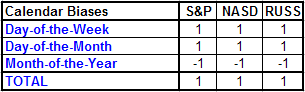
The calendar biases in the indexes are listed below.
DISCLAIMER: It should not be assumed that the methods, techniques, or indicators presented in this column will be profitable or that they will not result in losses. Past results are not necessarily indicative of future results. Examples presented in this column are for educational purposes only. These set-ups are not solicitations of any order to buy or sell. The author, Tiger Shark Publishing LLC, and all affiliates assume no responsibility for your trading results. There is a high degree of risk in trading.
Art Collins is the author of Beating the Financial Futures Market: Combining Small Biases into Powerful Money Making Strategies. E-mail him at art@traderinsight.com.
|



 Free Festival of Traders Videos


