The Feds broke their two-year cycle of consecutive rate hikes yesterday, but Wall Street was not impressed. Despite the Federal Reserve Board's decision to conclude the string of seventeen consecutive interest rate increases, the stock market sold off firmly upon the release of the afternoon announcement. The small and mid-cap stocks continued to drag the market down, as the Russell 2000 Index lost 1.2% and the S&P Midcap 400 slid 0.9%. The Nasdaq Composite closed 0.6% lower for the second day in a row, while the S&P 500 and Dow Jones Industrial Average lost 0.3% and 0.4% respectively. A bounce in the final fifteen minutes of trading lifted the broad market off its worst levels of the session, but each of the major indices still closed at new three-day lows (more for the Russell and S&P Midcap 400). The fact that the market reacted negatively to the Fed news is a great example of why we warned in yesterday's newsletter to avoid trading in anticipation of what you think the market's reaction should be rather than what actually occurs.
As we commonly see on Fed days, turnover was minimal in the morning, but spiked sharply higher after the interest rate announcement. By day's end, total volume in the NYSE had increased by 20%, while volume in the Nasdaq surged 33% higher than the previous day's level. The losses on higher volume caused both the S&P and Nasdaq to register another bearish "distribution day." A majority of recent down days have been marked by institutional selling and yesterday's session was no different. Market internals were negative, but not by a wide margin. In the NYSE, declining volume exceeded advancing volume by 2 to 1. The Nasdaq was negative by only 3 to 2.
Because it is such a slow mover that ties up a lot of capital in our $50,000 position model, we made the decision to sell our long position in the iShares Corporate Bond Fund (LQD). Although the actual price gain was less than a point, one thing to remember with the fixed-income ETFs is that they pay hefty dividends on a monthly basis. LQD, for example, just distributed a dividend of approximately 45 cents per share on August 7. Presently, we do not include ETF dividend distributions in our performance statistics, but we may do so in the future because a large part of the overall gain from the bond ETFs is derived from dividend payments.
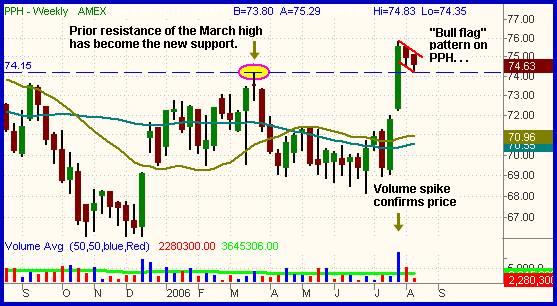
One sector we have discussed numerous times over the past two weeks is the Pharmaceutical Index ($DRG). Since the middle of 2005, the $DRG index has traded in a lethargic, sideways range. However, all that changed two weeks ago when post-earnings strength of several large-cap pharmaceutical companies enabled the $DRG to break out to a new two-year high. Since then, the index has retraced a bit of its breakout, but the retracement has not been too extreme. The pharmaceuticals have been showing relative strength in a weak overall market and should therefore be the next sector to surge higher whenever stocks eventually rally. The Pharmaceutical HOLDR (PPH) now sports one of the best looking charts in the sector. On the weekly chart below, we have annotated the "bull flag" pattern that has been forming on PPH since its recent high was set near the end of July. Notice also how its prior resistance has become the new support level:
In addition to PPH, there are several other ETFs in the healthcare and pharmaceutical sectors that also are looking good.
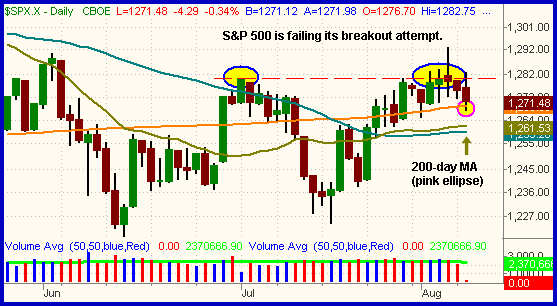
Taking an updated look at the broad market, it appears that the S&P 500's inability to close above its prior high at the 1,280 level is beginning to take its toll. As the daily chart below illustrates, the S&P 500 tested support of its 200-day moving average yesterday and we feel the bearish momentum in the afternoon is likely to result in the index falling back below the 200-MA within the next few days:
In anticipation of the S&P 500's failed breakout resulting in a collapse below the 200-day moving average, regular subscribers were notified by intraday e-mail alert that we took a bearish position on the index yesterday. However, we did not sell short the S&P 500 SPYDER (SPY). Instead, we initiated a long position in the new UltraShort S&P 500 ProShares Fund (SDS). That's right, we said it was a long position. As you may recall from our recent announcement, ProShares has launched a new family of ETFs that are inversely correlated to the direction of the broad-based ETFs. As the market moves down, these funds will move up. Even better is that they are available in a leveraged product that provides roughly a 2 to 1 percentage movement compared to the major indices. This means you no longer need to tie up a lot of capital selling short the SPY, then realizing that you may not be getting a lot of movement out of the trade anyway. Obviously, leverage can work against you just as easily, but that's not a big deal as long as you always have your protective stops in place and maintain consistent risk of capital with every position. Because SDS has a short price history, its chart is not very long-term. Nevertheless, notice how it broke out above its daily downtrend line yesterday, just as the S&P 500 broke support of its uptrend line from the July 18 low:
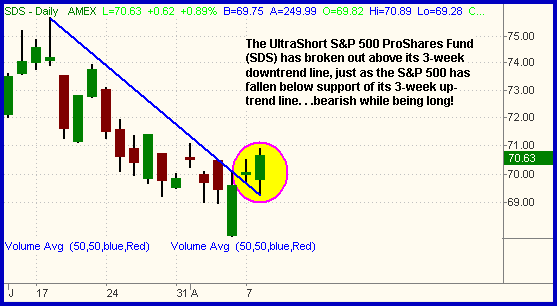
When an ETF has a short price history, the best thing to do for determining support and resistance levels is to simply look at the underlying index that it follows. Then, you can determine the approximate price level it corresponds to on the ETF itself. That is how we set our protective stop and target price on yesterday's SDS trade entry. Check out the ProShares web site to learn more about this new family of ETFs that is ideal for non-marginable retirement accounts in which you are not able to sell short.
Deron Wagner is the Founder and Head Trader of both Morpheus Capital LP, a U.S. hedge fund, and Morpheus Trading Group, a trader education firm launched in 2001 that provides daily technical analysis of the leading ETFs and stocks. For a free trial to the full version of The Wagner Daily or to learn about Wagner's other services, visit MorpheusTrading.com or send an e-mail to deron@morpheustrading.com.